
'The President is the President of the United States' - U.S. Soccer's JT Batson discusses Donald Trump's involvement with Folarin Balogun's suspended red card
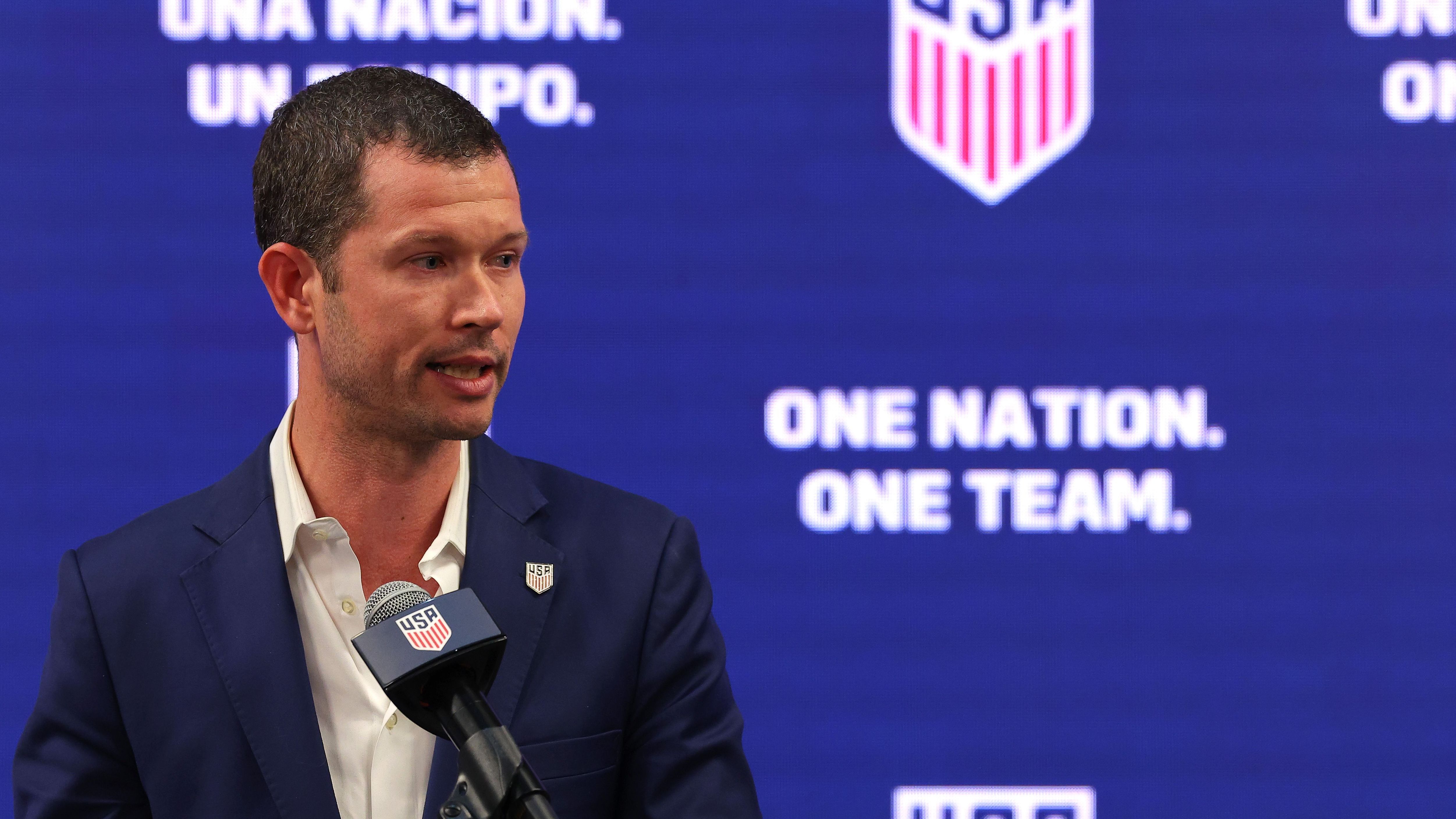
Batson spoke to reporters in Atlanta on Thursday alongside FIFA Chief of Global Football Development Arsène Wenger and U.S. Soccer COO Dan Helfrich, with the three outlining the next steps for American soccer following the World Cup. During the discussion, Batson was asked about the process that led to Balogun’s one-match suspension being lifted ahead of the USMNT’s clash with Belgium.In the days leading up to that match, which ended in a 4-1 USMNT loss, Trump and other government officials detailed their involvement, including the president’s phone call to Infantino. The intervention was widely criticized domestically and internationally, with Belgium particularly aggrieved by FIFA’s decision.On Thursday, Batson was asked whether it was a mistake for the White House to become involved and whether that represented a step too far."The president is able to do what the President wants to do," Batson said. "The President is the President of the United States. Obviously, we're incredibly grateful for all the support from all of our fans across the country, wherever they are, and we're excited about that. We know that that'll pay dividends going forward."He added: "I think the outpouring of sort of support was incredible, and at many points along the way, my phone blew up when people felt like we got a bad foul called on us or they felt like there was an opportunity for something to improve. I think that's a sign of us growing as a soccer culture. People care, and the fact that things cut through, the fact that people talked about it on sports talk radio in ways that soccer never would have been before, to me, that's a sign of the growth of our sport."Speaking to CBS this week, Balogun himself said the decision seemed to unsettle the team as they grappled with the outside narrative centered around the White House involvement."My initial reaction was I was happy to be back in the team," he told CBS, "but when I kind of started to reflect, I knew it was going to cause a lot of controversy, and I could almost see within my teammates a bit of nerves, because it's something that is so unique."He added: "The closer we got to the game, I tried to just focus as best as I could, but it was difficult. A lot of outside noise, and that's hard to avoid."Batson also reflected on the USMNT's World Cup as a whole and the lessons the program took away. As part of that discussion, U.S. Soccer says it is committed to taking things a step forward, starting with an overhaul of the youth system that will, ultimately, lead to better education. Wenger, in particular, spoke extensively about that education and the process it will take for the USMNT to become a member of the elite.For Batson, this summer was a step towards that, not the final step."There are lots of things that need to be true for us to continue to win World Cups on the women's side, and for us to truly compete for them on the men's side," he said. "Our focus is on putting ourselves in the best position to be able to do that. Obviously, our senior team performances matter, as do the state of our youth national teams, as do the state of our pathways more broadly, as do the state of our talent identification and development, as do the state of our coaching."I think one of our hopes is that we do a better job of educating our fans and educating our stakeholders on all of the things that matter. We want to be Argentina, we want to be Spain, competing in a final."As for the next man to lead that charge, it remains to be determined, Batson said. After the World Cup, both head coach Mauricio Pochettino and U.S. Soccer said there would be a period of reflection before either side decided on the future. That period is still ongoing, Batson said."As we shared, we were going to take a break after the World Cup and rest and recuperate," he said. "I didn't get to do too much resting or recuperating, but we're excited about the discussions. They've been active about long-term planning. As a recent example, we're active in our discussions with Steve [Cherundolo] around the U-23 role, and we're a key part of that process. We're feeling good about where we are overall, and we're looking forward to the discussions."While the World Cup remains ongoing, Batson and U.S. Soccer have had a little over a week to reflect on their part of it. For many, this World Cup was a culmination of years of work but, on the federation side, it is more so seen as another milestone on the path towards growth.That path remains ongoing, particularly with more tournaments coming to the U.S. in the coming years."From a U.S. Soccer standpoint, the 2026 World Cup has been incredibly successful and has fundamentally changed the trajectory of the sport in the United States," he said. "As we think about '94, '96, and '99, that five-year run, what it did to usher in an era of soccer in this country, we feel like we're one month into the next five-year period, this summer, LA [Olympics] 2028, and the Women's World Cup in 2031, to ultimately ensure that the U.S. is one of the world's great soccer countries."This summer's World Cup will conclude on Sunday with a match between Argentina and Spain in New Jersey. From a USMNT standpoint, the team will reconvene in September for their first post-World Cup matches.


Most Popular
Rohit Sharma no more automatic selection after Lord's ODI
27 minutes ago

