'He's got the whole world in his hands': How Sobers made his 365 not out

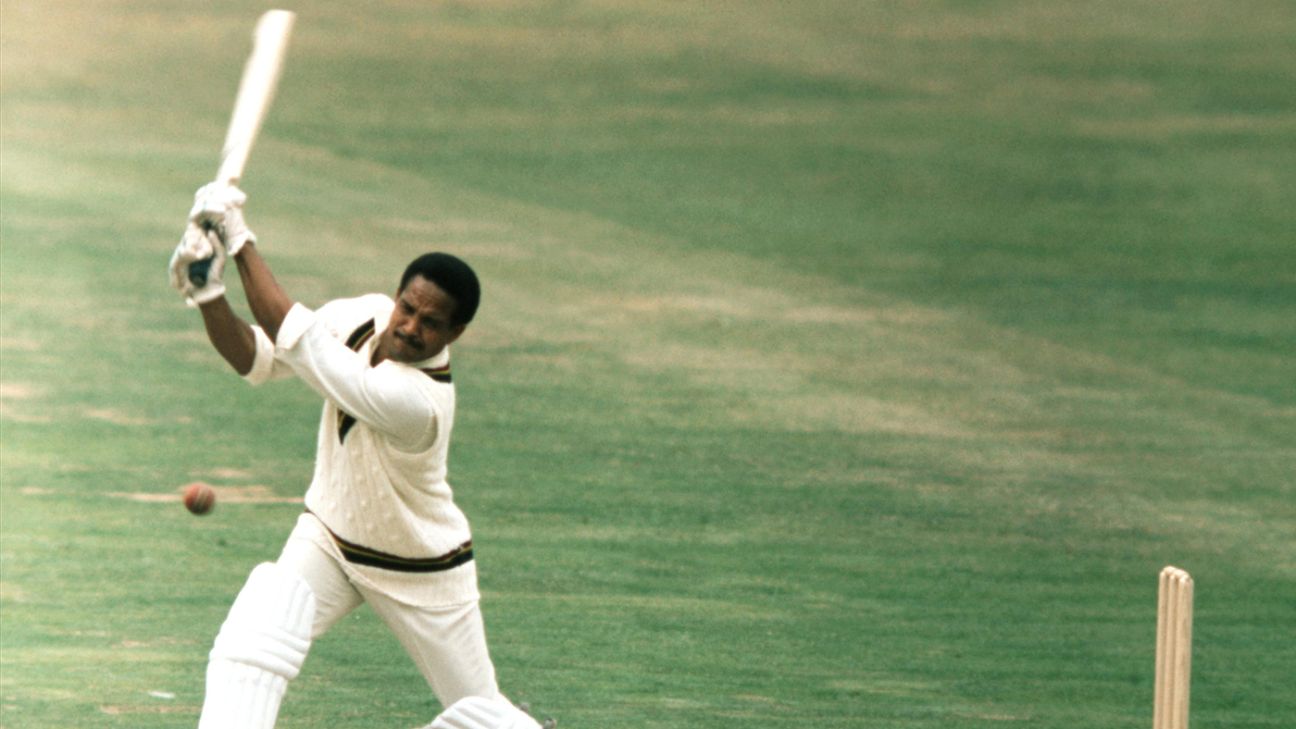
The Test career of Garry Sobers had, by the early months of 1958, been a series of little sparks; flashes of brilliance that illuminated short periods of play in his 14 matches. A mighty flame was about to ignite at Kingston's Sabina Park.The Caribbean was at a crossroads, on and off the field. The New Year saw the inauguration of the West Indies Federation, where the major islands came together as one with the intention of creating a single political entity that would go on to achieve independence from the United Kingdom. Historian Michael Manley called it "an enterprise as ill-fated as the 1957 tour of England"! In some ways, though, it was the perfect reflection of cricket in the region, given that internal conflict over its governance and functionality caused it to collapse after three years.Meanwhile, the West Indies team was evolving from that of the 1950s into one that would illuminate much of the next decade; the mantle passing from Weekes and Walcott, Ramadhin and Valentine to Sobers and Kanhai, Gibbs and Hall. One man, above all others, would be responsible for the successful transition."In 1958, wider historical omens apart, West Indies did far more than entertain Pakistan on their first visit to the islands. West Indians witnessed the coming of age of the game's third superstar," Manley recorded. "In the 19th century one man towers absolutely, WG Grace; between the wars, Don Bradman is the colossus. After the war, Garfield St Aubrun Sobers completes the triumvirate."Sobers welcomed the Pakistan tourists in Bridgetown by scoring an unbeaten 183 for Barbados, before being out for a duck in the second innings. A week later he began the Test series with 52 in a big West Indies total that featured an innings of 197 by Everton Weekes. Facing a first-innings deficit of 473, Pakistan were saved by a prodigious effort of concentration and technique by opener Hanif Mohammad, who played the longest innings in the history of first-class cricket. For hour after hour he remained at the crease, eventually scoring 337 in 970 minutes. His marathon ensured that even in a six-day Test the home team were unable to force a victory. Hanif also had some fun during the formalities of the West Indies' 11-over second innings, bowling both right-and left-handed.In the second Test, in Port-of-Spain, Sobers scored 52 and 80 in a 120-run victory. More little sparks. He had now made six half-centuries in 16 Test matches. On one hand, he welcomed being regarded as a front-line batter and the expectations that came with it. But he felt somewhat resentful towards those critics who held against him the fact that he had not yet made three figures. They had forgotten, he believed, that he had been picked originally as a spinner and had played several matches down the order.He was in no doubt that a century was close. He was too confident a 21-year-old to have developed any kind of mental barrier and was already wise enough to know that the manner of his batting was maturing. He knew he could be impetuous and acknowledged that his desire to continue playing shots and taking chances had prevented him capitalising on some good starts. "As you gain experience, you start to realise the value of your innings for the team and you start to improve your concentration," he said. Yet the perception of others was nagging at him. "I was becoming a little anxious about it," he admitted. "There were those who were wondering if I really would fulfil my potential as a batsman at Test level."In the third Test, in Jamaica, the Pakistan first innings ended on the second day at 328 all out. The tourists' attack was quickly depleted by injury to Mahmood Hussain, who was able to bowl only the first five balls of the West Indies reply before breaking down. Conrad Hunte, who marked his Test debut with 142 in the first Test, and Rohan Kanhai had put on 87 before Sobers came to the crease at the fall of Kanhai's wicket."Not my best position," he remembered of the No. 3 slot, "but on such a good wicket and with so many good players in the side, you wanted to get in as early as possible. I felt I was batting better in that series than at any time in my career." He was 20 not out at stumps, Hunte having reached a century in the final over of the day.The third day, a Friday, began with the team being presented to the Governor of Jamaica, Sir Kenneth Blackburne, Sobers the first in line to be introduced by captain Gerry Alexander.The clouds rising from behind the Blue Mountains at the north end of Sabina Park and the breeze that fluttered the flags on the pavilion were not enough to deter Sobers from walking out sweaterless and with sleeves rolled up.Around him the stands were packed to overflowing - to the point of danger, some might have said. In the cheaper seats, spectators bunched together, their almost uniform wearing of white shirts giving the impression of a sightscreen spreading around the arena. The members' enclosures featured splashes of colour; its occupants dressed as though ready in advance for their Sunday church services.Yet the spectators were not restricted to the designated seats. Legs dangled from the front of the second tier of the popular stands; bodies filled the trees like flocks of birds; others balanced atop the sightscreens; and, most precariously, the roofs of the stands were invisible under the additional layer of observers who had clambered on to them via a neighbouring building.Two years later, during England's visit, several people would be injured, including one who suffered a broken leg, when a section of roofing collapsed under the weight of interlopers. Noting that the official capacity of 15,000 "looks more than the ground can safely hold", EW Swanton observed, "The atmosphere of Test matches in these islands is quite tense enough without such additional hazards as this, and it is impossible in this case not to condemn both the ground authority and the police... Every facility was strained to bursting point and beyond.'On the field, Pakistan's attack was further depleted by the non-appearance of spinner Nasim-ul-Ghani, who had fractured his right thumb while fielding the previous day. The visitors now had only two fit front-line bowlers, meaning skipper Abdul Kardar would be forced to ignore doctors' orders not to bowl his slow left-armers because of a fractured finger. The stage was set perfectly for Sobers to achieve his elusive milestone.Revelling in the fastest wicket he'd encountered, he moved into the 40s with three consecutive fours off Khan Mohammad. By lunch he was on 76 and his tenth boundary, scored off Kardar, saw him reach 97, one stroke from his century. He was happy to get there one run at a time, eventually reaching 100 in 191 balls with a single off Kardar. I was concentrating so hard I remember little about it, he explained. "The shot, the bowler or the reaction of the crowd. I felt a sense of great relief; a vast obstacle in my career had been removed."Taking a deep breath, he settled himself by playing out a maiden, and then, his burden lifted, launched into attack. He raced to 150 with a burst of run-a-ball scoring that included a further eight fours. At 144 he had reached 1000 runs in Test cricket. He went to tea on 170, not far behind Hunte's 196.With his partner passing 200 soon after the interval, Sobers now had his own double-century in his sights, proceeding with more circumspection. It was not until he was ten runs away that he found the boundary again. On 199 he faced Khan, reaching his landmark with a five. Once again he celebrated his achievement with a flurry of fours. When play closed, West Indies were 507 for 1, with Hunte (243) and Sobers (230) having become the fourth pair to bat unbeaten throughout an entire day of Test cricket.For once, Sobers was unsettled by the talk of potential records. Len Hutton's highest score in Test cricket, 364 for England against Australia at The Oval in 1938, was conceivably within range of either batter, which gave him a restless night.Not that he was fretting about the spectre of dismissal. "I felt I could bat on and on and that no one could get me out." Nor did he arrive at the ground feeling tired. Excitement and adrenaline pumped life into his limbs.The Hunte-Sobers partnership ended early on day four at 533, when Hunte was dismissed for 260, thrown out by substitute fielder Aijaz Burt when he tried to push Khan for a quick single. The duo had put on 446, a West Indies record for any wicket and only five short of the record then for the second wicket in Test cricket, set by Bradman and Bill Ponsford against England. In fact, it was a piece of misinformation that contributed to the partnership's termination, Hunte having believed that one run would tie the record. Sobers could also have been run-out when new batter Weekes played Khan through midwicket and sent back his partner when he set off for a run. Substitute Waqar Hussain's throw to the wrong end meant Pakistan's only chance of dismissing Sobers had gone. Soon after, he took a single off Khan to reach 250 for the first time in his career.It was only when Weekes was caught at slip shortly after lunch, bringing Clyde Walcott to the wicket, that Sobers became fully awake to the possibility of a record. At 602 for 3 he assumed that skipper Alexander must be contemplating the termination of the innings, but Walcott greeted him with, "Don't worry. Settle down. Take it easy. The runs will come and I will give you as much strike as I can."Sobers insisted in later years that a declaration would not have disturbed him. Even before the record was the target of a score of 300. Fours became sparsely dotted amid the singles and occasional twos that kept his score ticking towards that mark.The boundary he scored off Mahmood to go to 299 was only his third in his previous 52 runs. Two deliveries later, he became his country's first triple-centurion. He gave up trying to put the record out of his head; instead, he attempted to convince himself he was new to the crease and needed to score 65 to win the match.His delight at passing another landmark had once again taken away any physical tiredness, and following the pattern he'd established after reaching 100 and 200, he was sufficiently tension-free to go back on the attack, smashing Khan for four boundaries in two overs. At tea, taken at 730 for 3, he was on 336, Hutton's mark only 28 in the distance.Now he was back to picking up his runs in ones and twos, Hanif running in from the outfield to shake his hand when he went past his 337 of the first Test. It was an unblemished innings, full of delightful strokes, though we who were on the end of it could perhaps be excused for not sharing in the delight, Hanif recalled. "Only once did it seem possible there was a chance when he played a ball which took the outside of his bat, and went towards the slips, where Fazal [Mahmood] was supposed to have been fielding. He, however, was standing somewhere near third man, tired after having completed a long bowling spell and was nowhere near."The landmark of 350 was relevant to Sobers only as a stopping-off point towards the record that everyone was willing him to achieve. "The noise from the spectators was incredible," Sobers noted of a stadium that Swanton observed was traditionally more reserved in its behaviour, and less appreciative and knowledgeable than those in Bridgetown and Port-of-Spain. In Barbados, there was barely a transistor radio not tuned in to events in Kingston.When he had reached 363, Pakistan offered a second over of the innings to Hanif, the man Sobers had always imagined would be the one to beat Hutton's record. After Walcott scored a single off the second ball, Hanif changed from right-handed bowler to left. In Sobers' usual retelling of the moment, he was informed by the umpire of the change and responded, "He can bowl with both hands if he likes."Sobers stroked the second ball he received down the ground to long-off and comfortably took the run that tied the record as the crowd erupted. While the cheers intensified, Sobers took the opportunity to clear his head, watching as Walcott took his own score to 88 by launching Hanif into the stands.New over, Fazal Mahmood running in to bowl. Wide. Then a dot ball. Then Sobers pushed into the covers, Walcott called for the run and Sobers' dash to the bowler's end gave him the highest score in the 81-year history of Test cricket.According to Manley, he had "redeemed all the pledges that had been implicit since the first morning against Hutton's side four years earlier."Sobers accurately recalled that "Sabina Park was in a state of bedlam". While those on the roofs and sightscreens fought to maintain their balance as they cavorted with joy, hundreds at ground level raced to the square to pat their new hero on the back, or merely to be in the vicinity of greatness. It might have been quite a shock to some people, Weekes suggested, "but to some of us who were very close to him we realised at that stage he had the ability to do what he did".By the time the crowd had dispersed - and Alexander had confirmed his team's declaration - Pakistan skipper Kardar was canny enough to complain that the pitch had been damaged by the stampede and required overnight repairs."Pandemonium broke out," the Barbados Advocate noted. Reflecting the ever-present island rivalry, it continued sniffily, "The unprecedented display of enthusiastic but bad behaviour by a section of the record crowd of 20,000 that watched the day's play brought an abrupt ending 55 minutes before the scheduled close in an atmosphere of wild scenes and confusion that marred the glamour, brilliance and history-making achievement of the gifted left-hander."Sobers ended the day feeling guilty that his chanceless 575-ball, 614-minute innings, which included 38 fours and a five, might have jeopardised his team's chances of forcing victory by costing them bowling time. "That is one of the reasons why I have always scored my runs quickly," he would explain. "I can never remember making runs just for the sake of making runs."Yet with two days remaining, he hardly needed to worry about a few lost minutes, and West Indies duly dismissed Pakistan for 288 early on the sixth and final day, taking a 2-0 lead in the series.Sobers' life had changed irrevocably. "From that moment on, I was instantly recognised throughout the Caribbean and the cricketing world," he said. When he returned home, the proud Barbados Cricket Association arranged for him to be driven through the streets to take the cheers of his people. There was no immediate impact on his bank balance, however. He had to be content with the basic match fee of 150 British West Indies dollars - not much more than £30 at that time - which offered good value for the West Indies Cricket Board of Control.The series moved on to Georgetown, where Sobers opened the batting and scored 125 in just over four hours, sharing a second-wicket partnership of 269 with Walcott. He batted at three in the second innings, taking guard with 125 of the 317 required to win already scored. There was still enough opportunity for him to rattle off his third consecutive century, hitting an unbeaten 109 off 130 balls as the target was reached for the loss of two wickets.The run of three-figure scores came to an end in Pakistan's consolation victory in the final Test, in Port-of-Spain, but by the time the series ended, his overall Test batting average had been raised to 53.43. It would never again dip below 52, and, in fact, would spend most of the next 15 years climbing higher.Almost unnoticed under his pile of runs was the fact that Sobers managed only four wickets in the series at an average of 94.3. But his having totalled 824 runs at an average of 137.3 meant no one cared too much about his bowling.As the series ended in the Caribbean, a new record was all the rage across the sea in the United States, reaching No. 1 on Billboard's most-played chart and staying there for four weeks, selling more than a million copies and earning its performer, Laurie London, a gold disc. It was a reworking of an old African-American spiritual, but it reflected perfectly the new status of Garry Sobers: "He's Got the Whole World in His Hands".



Most Popular