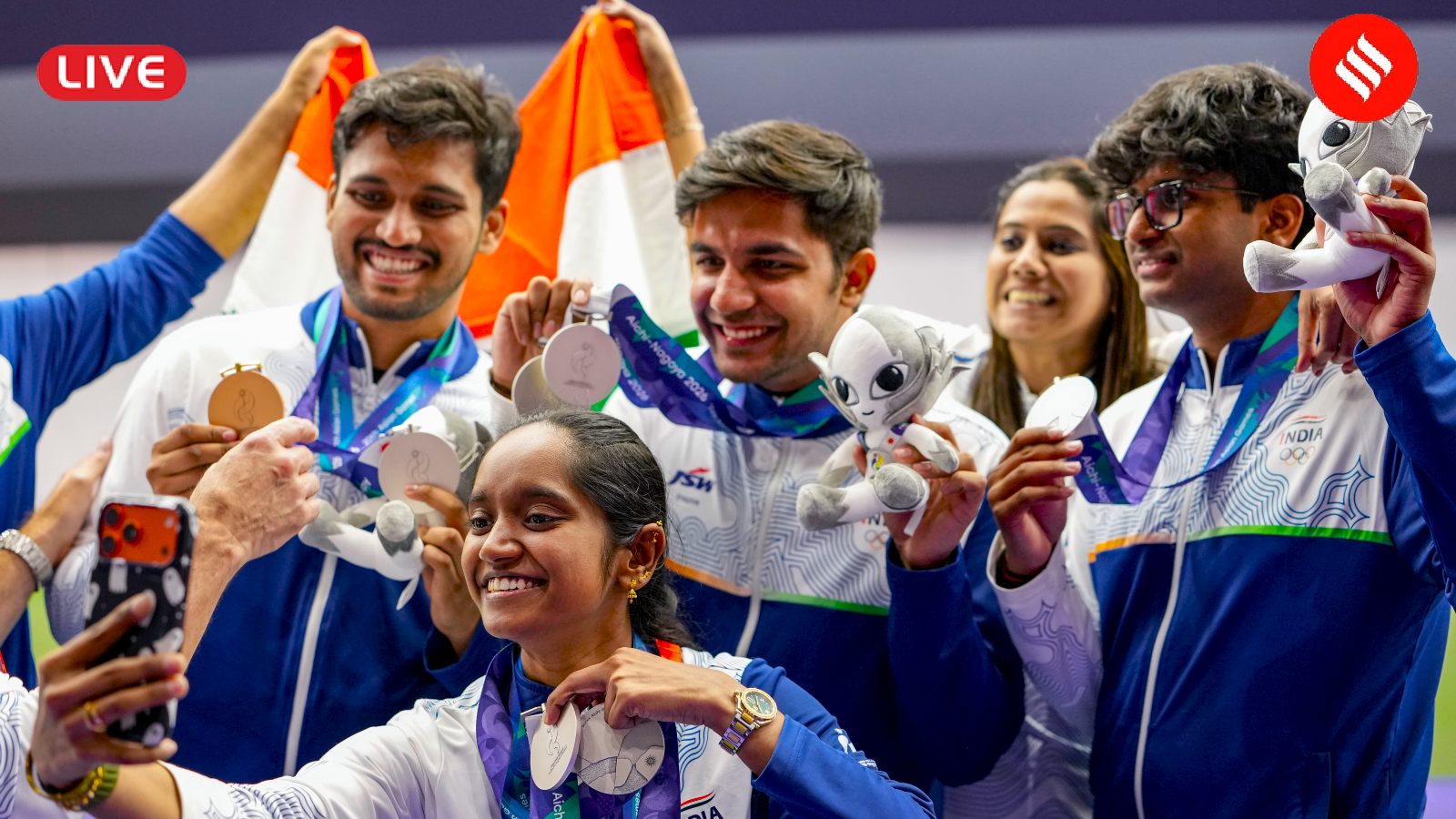
Asian Games 2026 Live: India beat Pakistan in men’s table tennis; 3 medals from shooting range
– From Shivani NaikYonhap News reported that it has come to light that North Korea's air rifle shooting team at the Aichi-Nagoya Asian Games, were denied permission to participate in the women's air rifle competition on Sunday due to issues related to firearms and ammunition.North Korea did not participate in both the women's 10-meter air rifle shooting individual and team events that morning, as their seats went empty.Turns out an official from the organizing committee told Yonhap, "North Korea has not obtained the necessary prior approval from the Japanese government to use ammunition, so its participation in the competition is uncertain." The relevant guidelines mandate that to participate in international shooting competitions, one must go through strict procedures, including declaring the serial number of the firearm and the quantity of ammunition to the relevant authorities in advance.The DPR shooters claimed the North Korean national team had sent detailed information to the organizing committee several months ago, ahead of dispatching six shooters to Japan, three men and three women. Shooting is considered one of North Korea's signature sports, having won them 41 gold medals at the Asian Games so far. However, the specific details, such as whether North Korea actually went through the relevant approval procedures or whether the Japanese government rejected the application, have not yet been confirmed.The men's Team also did not show up.- From Shivani NaikSindhu vs YamaguchiA 31st faceoff in the Battle of Eternity cannot possibly be a grudge match. But PV Sindhu 16-14 Akane Yamaguchi makes this an eternal tussle. History favours Sindhu - she beat Yamaguchi for the Japan Open Super 750 crown. She has also beaten the Japanese at Tokyo Olympics. But that's where the grudge resides. Yamaguchi can be a cool cat in high stakes team games with more experience of Team Knockouts given Japan's Uber Cup battles with Korea / China. That precisely can help Sindhu pile pressure on Yamaguchi at home. She has a dream team of coaches - Irwansyah and Pullela Gopichand, and needs to nail down the first point. She skipped the opening ceremony and trained hard instead. Worth missing sleep and for a 6 a.m start for Indian fans.XxxWho can test Miyazaki mettleTomoka Miyazaki is probably riding a crest currently having beaten Chinese Wang Zhi Yi recently, though steadying her Top 10 status was tough for the 20-year-old. Compared to the consistency of Early-Nozomi Okuhara and Akane Yamaguchi, Miyazaki has taken her time. But here she is -- the aggression louder and attack swifter. She poses a question to India's Gen Next - and there's enough chatter on whether Unnati Hooda or Tanvi Sharma should face her. Neither has a win, but Tanvi has taken 2 sets off the Japanese in two matches before being drowned in the deciders' endgames. She frittered leads of 10-7 and 13-11 before the World No 7 raced to the finish. It's about getting overwhelmed and shot selection. Coaches Gopichand and Irwansyah should be at hand for those nerves. But the same applies to Unnati Hooda. She's 0-4 down which looks more dire. But smart coaching reflects very immediately on her game, and if she can navigate Miyazaki's limited deception, she can pull one out. Ofcourse a lot will depend on how the first two matches WS1 and WD1 go.Also, it's Teams - medal playoff. Expect the coaches to spring a surprise. India beat Japan's next best for Asian Team Championships title three seasons back. This is the hosts' main side though.XxxTreesa-Gayatri vs Yuki Fukushima/Mayu MatsumotoThe Japanese are the top rated of the many Japanese pairs, and Fukushima - Matsumoto are currently ranked World No 3. Treesa-Gayatri did well to beat the other Top 10 pairing of Rin Iwanaga-Kie Nakanishi at Delhi World Championships. But the hosts Japanese will be far more prepared and throw their top pair at the Indians in a grudge match that could get crackling. Fukushima-Matsumoto have won their previous encounter, but not before things got interesting. It was a 21-13, 24-22 scoreline in June of 2025 but the Indians couldn't convert two set points despite leading for 20 of the 22 points they scored in the second. The Japanese took the only two leapfrogging points that mattered - so this will call for patience. Matsumoto can amp up the attack at will and Japanese defense is always relentless. It's 49-51 in favour of Japanese for experience (33/31 years old). But that 49 needle is sliding to 50, because of the energy of the pair of 23 year olds. And the external brain-trust: Coach Gopichand & Tan Kim Her.WS3 & WD2Nozomi Okuhara is back in the Top 10, that's three Japanese in Top 10 so Indian confidence is slightly dreamy and dashing and what's to be gained from being pessimistic, really?But Okuhara - should the tie get to 2-2, presents an opportunity. She has been playing well before her World Championship retirement. And Tanvi Sharma might well prove more effective against her than vs Miyazaki. Though the temptation to throw an unheralded Devika Sihag on Okuhara will be strong. Big decision night for India.Tanisha Crasto might also be a good X-factor to drop into the second doubles mix, though the two points have to come from Sindhu & Treesa-Gayatri without leaving things to the improbables.From Shivani NaikNikolajs Mazurs is a 6 foot point guard from Latvia currently serving as South Korea's basketball coach. Amidst the plethora of disasters striking Koreans at Japan's Asian Games, the latest was the team bus not turning up to ferry the basketball team to the final against Japan.The Asiad gold tends to be important fir Koreans for exemption from military service. (Korea was last week requested to deploy ground troops in middle east / West Asia, but protests broke out leading the PM to decline Americans). But the gold is nevertheless crucial and far more significant than just an Asiad gold medal.Still, the Koreans needed to reach the stadium to play Japan in finals, and ended up walking to the venue. It's whythe South Korean basketball coach Mazurs, when asked about the bus not arriving, said, "Let's think positively. That stuff isn't important. Because the bus didn't come, we were able to walk. The weather was nice, and while walking together as a team, we got to see some great scenery too."Whatever the resentment - seemed to have evaporated, and South Korea took gold by defeating hosts Japan 67–57 in the final. This was South Korea's first men's basketball gold medal at an away Asian Games since 1982, and much treasured. The Latvian received much gratitude from the beleaguered Japanese, as did the team that wished Japan good luck as it chases World Cup qualification in the future.All's well that ends with Korea winning gold, and not being put in harm's way and staying safe in these scary war-tinged times when troops and their families are on the edge.The Indian sepak takraw team have surged into a 9-4 lead in the second set of their men's regu clash against the hosts Japan. (Regu: a Malaysian word meaning a team.)The Japanese team have been flailing ever since a contentious net call went into the favour of India in the first set. The Japanese coach led a long protest, that seems to have affected the concentration of his own team.Quick guide to sepak takraw:Sepaktakraw originated in Southeast Asia, but its full history and origins are not well documented. However, it is believed that the game was first played in Malaysia, and then spread to other neighbouring countries such as Thailand, Indonesia, and the Philippines.The name ‘sepaktakraw’ comes from the Malay language, with ‘sepak’ meaning ‘kick’ and ‘takraw’ meaning ‘woven ball’. The game involves players using their feet, knees, chest, and head to pass a rattan ball over a net, in a similar fashion to volleyball.There are various accounts of how the sport was first played. Some stories suggest that villagers using a woven ball made from rattan or bamboo partook in a game resembling sepaktakraw. Others believe that it was originally played as a form of military training, where soldiers would practise kicking a woven ball as a way to improve their agility and footwork.Regardless of its origins, the modern version of sepaktakraw became popular in Southeast Asia in the 1940s. Standardised rules and an official name for the sport were decided upon in 1960.Sepaktakraw has been included in the Asian Games since the 1990 Games in Beijing, People’s Republic of China.



Most Popular