Tennis’ hindrance call explained: Jack Draper hit by controversial decision against Daniil Medvedev
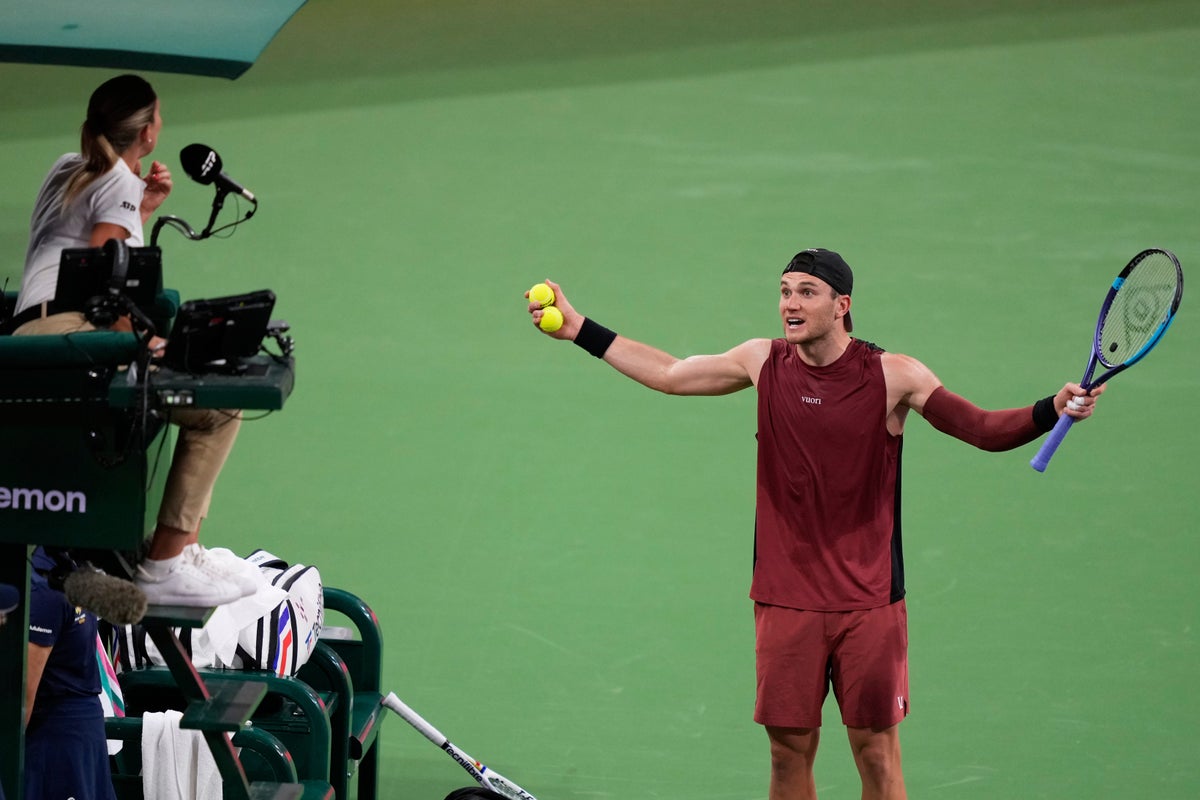
Jack Draper's Indian Wells title defence ended in controversial fashion as he suffered a quarter-final defeat to Daniil Medvedev, reigniting the debate surrounding tennis’ hindrance rules.The decisive moment arrived at 5-5, trailing 0-15 in the second set, with Draper already a set down. Needing to fight back to deny Medvedev the chance to serve for the match, the British No 1 levelled the score after his opponent hit a backhand into the net, only for Medvedev to appeal to umpire Aurelie Torte claiming hindrance.Medvedev had taken issue with Draper raising his arms at a disputed line call midway through the point and after a video review, Torte deemed Draper to have distracted his opponent and awarded a crucial point to Medvedev, allowing him to break.The California crowd made their feelings clear, booing Medvedev at the change of ends and after he sealed victory. The two players had a long chat at the net as they shook hands, with Medvedev saying: "If you're mad at me, I'm sorry," and Draper responding: "I'm not at all - but I don't think it distracted you enough".It’s the latest instance of contention surrounding the hindrance rule - but why is it in the game, and what are its ins and outs? Here’s everything you need to know.The hindrance rule in tennis is designed to stop a player affecting their opponent’s shot.It can also relate to a line judge making the wrong call (i.e. shouting “out” when the ball was actually in), which results in the point being replayed unless “it was a clear ace or a clear winning shot that the player could not possibly have retrieved”. But we will be focussing on “inadvertent or deliberate” hindrances, as detailed under Rule 7.22(F) of the ATP Tour’s 2026 Rulebook.When a hindrance occurs, it may ruled as inadvertent or deliberate. This will influence the umpire’s course of action - which will likely see the point either replayed or awarded to the opponent.Inadvertent distractions can relate to next to anything happening unintentionally. This includes but is not limited to a ball falling out of a player’s pocket, a hat falling off, or an involuntary sound or exclamation from a player, such as a verbal exclamation to an injury. Per the rulebook, these unintentional offences will lead to a let (the point is replayed) and a warning, with the umpire advising the player in question that a repeat of the incident will result in the loss of a point.Deliberate hindrances, on the other hand, will lead to the loss of a point without warning. ATP says “the player meant to do what it was that caused the hindrance or distraction” for an offence to be deemed deliberate. Offences can include exclaiming or speaking during the point, as well as waving your arms in a manner deemed distracting for your opponent.The latter applies to Draper’s incident, with the umpire telling the Brit: “You did something different in the rally than you would normally do. Now if he [Medvedev] is asking for it, it means that he saw it.” She went on to stress that in this scenario, “the benefit of the doubt” is given to the opponent.Controversy regularly surrounds deliberate hindrance calls due to the often-subjective nature of the decisions, which can lead to pivotal points being awarded the other way - as Draper has just experienced first-hand.World No 1 Aryna Sabalenka was notably called out during her 2026 Australian Open semi-final against Elina Svitolina after reacting to a shot she thought she had missed with her trademark grunt. The ball actually went in but umpire Louise Engzell deemed the extra noise as a hindrance to Svitolina as she went to return the ball. Sabalenka protested, albeit briefly, and lost the point.Medvedev, the beneficiary of Draper’s umpiring row at Indian Wells, has himself been at the centre of hindrance drama in a viral moment from the 2021 Toronto Open.Against Alexander Bublik, Medvedev leathered a smash close to the net that accidentally went straight at the Kazakh player. Bublik somehow managed to block it with his racket but with the ball looping harmlessly back over the net and Bublik on his backside, Medvedev had the simple task of hitting into an open court and win the point. But silence is golden in tennis and after Medvedev audibly said “sorry” while the ball was still in the air, the umpire ruled a hindrance and awarded Bublik the point.“Can you imagine how stupid this call is?” Medvedev said over the net. “He’s laughing at you [the umpire]! This is unbelievable what you have done!”Inadvertent hindrances, meanwhile, rarely spark outrage to the same extent due to the fact they are often brushed off by the umpire, but that didn’t stop Dan Evans calling for the “worst rule” in tennis to be changed after overcoming Jeremy Chardy at the 2023 Australian Open.Chardy, who suffered defeat in their second-round match, was left furious after a ball fell out of Evans’ pocket, which by the book should’ve led the point to be replayed - but umpire Miriam Bley did not pick up on what had happened until a split second after the Frenchman netted.An irate Chardy accused the umpire of lying but Evans later argued that it was the rule, not the incident, that should come under scrutiny. “If a ball comes out of your pocket, it's your own fault." he said.Draper was not satisfied with the judgement but did not dispute the result, telling BBC Sport: "First of all, Daniil was the stronger player fair and square."It's a difficult situation for the ref. I don't think I did enough to hinder him but, at the end of the day, I did make a slight thing with my hands. On one hand, I get it but on the other I don't think it was enough to distract Daniil."If he had missed the next ball and it was very clear that I had hindered him, then I would get it."I think he's played the rules quite well. The rally carried on and I was able to win the point so I don't think I should have lost the point. I think it's pretty harsh."Medvedev, who told Draper during the review that he “whatever she decides, I will be OK with it”, made it clear he had done nothing against the rules, despite the crowd's opprobrium."Was I distracted big time? No. Was I distracted a bit? Yes," he said."Is it enough to win the point? I don't know. If you look on the first forehand I do after it happened, I think I could have done a better shot if there was no gesture from Jack."Do I feel good about it? Not really, but I also don't feel like I cheated. I let the referee decide."The Russian later added that he had grown more regretful of how the incident played out, telling Sky Sports: “My thoughts during it were different. Now honestly I feel a bit tough with what happened because it was an important point in the match and to win a point like this is not amazing.”

Most Popular