
Pakistan cricket has become a laughing stock and the circus rolls on
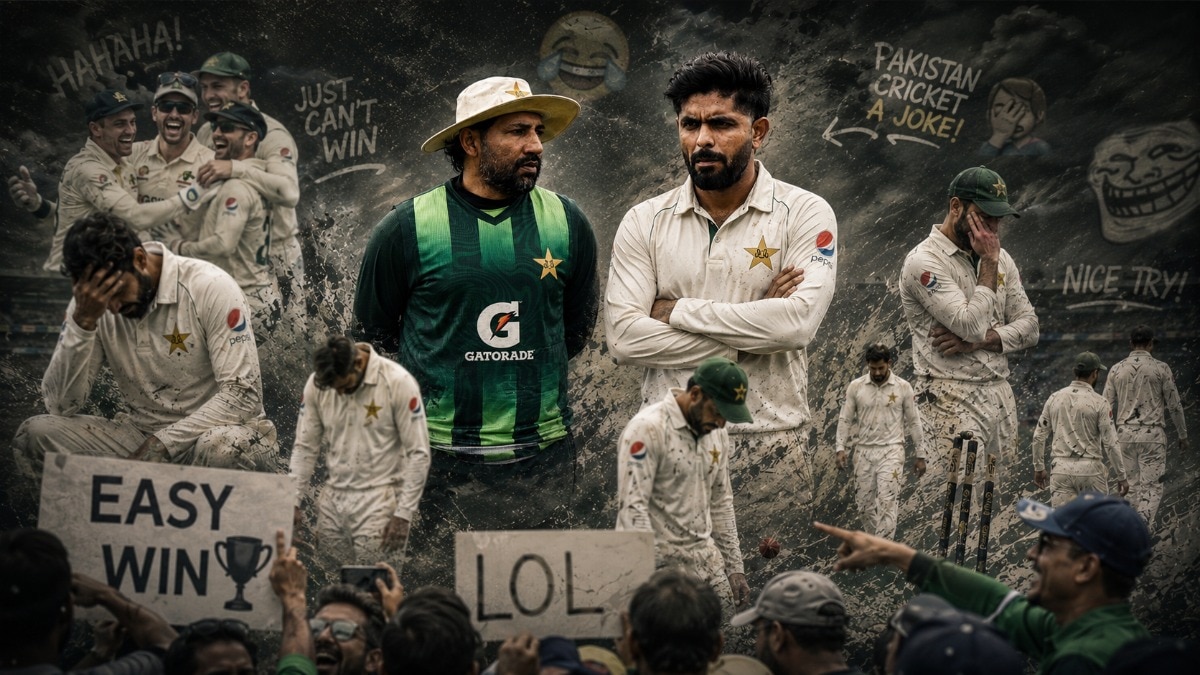
There was a time when Pakistan cricket's chaos was almost part of its charm. The team could be unpredictable, volatile and wonderfully gifted at the same time. A collapse could be followed by an extraordinary comeback, sometimes when nobody saw it coming.But there is a difference between unpredictability and dysfunction. Pakistan cricket now seems to be struggling to tell the two apart.It has, increasingly, become a laughing stock. Just when it feels like the team has reached a new low, something happens to take it further down. Losing heavily to England was bad enough. Going 2-0 down in the Test series with one match still to play was worse. Then came the extraordinary mid-series overhaul involving seven players, changes to the coaching staff and more upheaval in the selection setup.And all of this happened while Pakistan were still in England, with one Test left and a chance, however slim, to salvage something from the tour.Pakistan lost the first Test at Headingley by an innings and 103 runs before England beat them by 194 runs at Lord's. They failed to reach 200 in any of their first four innings, scoring 171, 135, 110 and 194.The cricket was poor. The response was extraordinary.TOO MANY CHANGES, TOO SOONThe scale and timing of the response are what stand out.Seven players — Mohammad Rizwan, Salman Ali Agha, Imam-ul-Haq, Ali Usman, Aamer Jamal, Awais Zafar and Khurram Shahzad — were released, with seven replacements brought in, including five uncapped players.Sarfaraz Ahmed, appointed head coach only in April, was removed, while bowling coach Umar Gul also departed. White-ball coach Mike Hesson was handed charge of the Test side for the final match, with Ashley Noffke joining the coaching staff.Misbah-ul-Haq also resigned from the selection committee, adding to the feeling that Pakistan's cricketing structure was being pulled apart while the team was still on tour.There is nothing wrong with making difficult decisions. Players lose form. Coaches fail. Selection committees get things wrong.But doing all of this with one Test left raises a fairly obvious question: where was the planning before the tour?If seven players can suddenly be deemed surplus to requirements, what does that say about the process that picked them in the first place? And if a coach appointed only months ago can be removed after two series, what exactly was the long-term plan?Former Pakistan captain Ramiz Raja said the PCB had pressed the "panic button." Shahid Afridi also criticised the move, while former coach Mickey Arthur called the decision "absolutely ridiculous."The issue is not simply that Pakistan are losing. It is that nobody seems to know what the answer is.TOO MANY COACHES, NO STABILITYThe latest upheaval is not an isolated episode. It is part of a pattern that has followed Pakistan cricket for some time.Look at the coaching turnover. Gary Kirsten took charge of Pakistan's white-ball teams in April 2024 on a two-year contract but resigned only six months later.Jason Gillespie, appointed Test coach at around the same time, also left in December 2024. His departure came after his authority had been reduced and amid disagreements with the PCB over the running of the Test setup.Two coaches brought in together to give Pakistan a fresh direction were therefore gone within the same calendar year.Then came another reset.Sarfaraz Ahmed has now been removed after only two series in charge, having overseen five defeats in six Tests. Hesson, appointed as the white-ball coach, has suddenly been asked to take charge of the Test side instead.It is difficult to call that a rebuild when the people brought in to rebuild the team keep getting replaced.Coaches arrive with contracts and plans. Then, before those plans have had much chance to take shape, the coach is gone or his authority is reduced.A new coach arrives with a new philosophy. Players are selected around it. Roles change. The team starts another cycle.Then comes a poor run of results and the cycle starts again.The problem is not that coaches should never be removed. Sometimes they have to be. The problem is that there seems to be very little continuity.A coach needs time to understand his players. Players need time to understand what their coach wants. Young cricketers also need some security that a difficult few months will not lead to the entire structure around them being changed.Pakistan instead seem to operate on a much shorter clock. Lose a series, change something. Lose another, change something else. Eventually, the changes themselves become the defining feature of the team.The irony is that Pakistan have already shown what continuity can produce. Under Misbah-ul-Haq, the Test side developed a clear identity and reached No.1 in the world in 2016.The contrast with the present is hard to ignore. A rebuild needs time. Pakistan keep changing the people expected to carry it out.YOUSUF RAISES BIGGER QUESTIONSMohammad Yousuf's intervention made the situation even more uncomfortable because his criticism went beyond selection.After Pakistan's batting problems surfaced again in England, Yousuf accused coaches of failing to address technical flaws in Babar Azam and other players when those problems could still have been corrected."These coaches are poison for the game," Yousuf wrote, arguing that they lacked vision, blocked progress and misled talented players. He said technical deficiencies that could have been fixed years ago had instead become glaring weaknesses, exposed from Bangladesh to England.That is a damning accusation.Whether one agrees with Yousuf or not, his central point is hard to ignore. Pakistan are not short of talented cricketers. They are short of a system that consistently develops that talent and gives it time.Babar is perhaps the clearest example. A player of his ability has repeatedly found himself searching for rhythm and technical certainty in Test cricket. The wider batting group has looked equally vulnerable, managing four totals below 200 in the first two Tests against England.And these are not problems that suddenly appeared in England. They have simply become much harder to hide.WHO IS RUNNING PAKISTAN CRICKET?That may be the biggest question of all.A team can survive a bad coach. It can survive a poor selection call. It can even survive a disastrous tour.What becomes much harder to survive is a system where responsibility keeps moving from one person to another.When a coach goes, a new coach takes over. When the results do not change, the players are changed. When that does not work, selectors are questioned. Then the coaching staff is altered again.At some point, it becomes difficult to know who is actually accountable.Who decided the original squad? Who backed the players who were sent home? Who appointed Sarfaraz? Who decided, after two Tests, that he was no longer the right man? And who decided that the answer was to bring in seven new players with one Test remaining?Those questions matter because Pakistan's latest overhaul was not simply a selection change. It was a wholesale response to failure, carried out in the middle of a tour.And the more often these decisions are made, the harder it becomes to believe there is a coherent plan behind them.At the centre of that uncertainty sits Mohsin Naqvi, the PCB chairman who also holds one of Pakistan’s most powerful political offices as the country’s interior minister. That dual role has placed him at the very top of the cricketing and political hierarchy, yet Pakistan cricket continues to look increasingly driven by noise rather than direction.Under Naqvi, the headlines have often been about sweeping changes, dramatic announcements and public posturing, while the harder questions about performance, planning and accountability remain unanswered. The danger is that cricket becomes theatre: plenty of movement, plenty of messaging, but very little evidence that the underlying system is actually getting better.NOW EVEN THE CHAOS IS A JOKEPerhaps the clearest sign of where Pakistan cricket stands is that former players are no longer just criticising the team. They are joking about the chaos.Kevin Pietersen mocked the latest upheaval by suggesting that perhaps the toss should be conducted the night before so the captain has enough time to explain the squad.It was a joke. But it landed because the situation itself has become almost unbelievable.Pakistan cricket used to frighten opponents because nobody knew what extraordinary thing the team might do next.Now, opponents and observers are left wondering what extraordinary administrative decision might come next. That is the real decline.The talent is still there. The passion is still there. The cricket-mad public is still there. What appears to be missing is stability, accountability and a clear long-term vision.Pakistan do not need another dramatic reset. They need to stop resetting.Because every time it feels like Pakistan cricket has hit rock bottom, another decision comes along to show that there is, somehow, another floor beneath it.- Ends



Most Popular



FIFA Backs NFF Reforms After Mass Resignations
4 hours ago