Messi the link between Argentina and Spain’s colliding contrasts
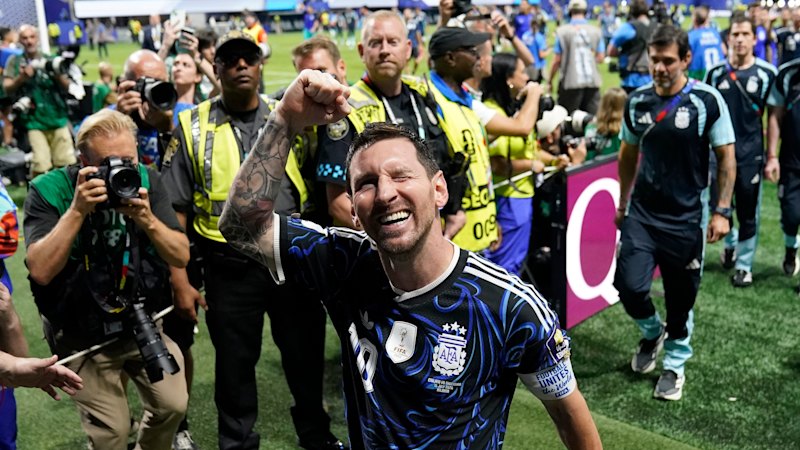
July 19, 2026 — 5:00amYou have reached your maximum number of saved items.Remove items from your saved list to add more.It has been 10 years and 21 days ago since Lionel Messi retired from international football. He had just missed his penalty in a shootout against Chile to decide the 2016 Copa America Centenario champions, could not comprehend that Argentina had lost a fourth major final in nine years, and called it quits immediately.He was 29, but by then had spent so many years in pursuit of an elusive international achievement to match his resplendent club career (he had won, by then, five of his eight Ballons d’Or). The 2014 World Cup final loss to Germany – he missed a one-on-one with Manuel Neuer – only intensified the criticism in Argentina, including accusations he prioritised Barcelona over national duties and lacked the yearning and leadership of Diego Maradona.“I’ve done all I can. It hurts not to be a champion,” he told media after the loss to Chile at MetLife Stadium in New Jersey. “It’s been four finals – I tried. It was the thing I wanted the most, but I couldn’t get it, so I think it’s over. I think this is best for everyone.”In Buenos Aires, a 15-year-old River Plate academy player named Enzo Fernandez did not think it was best for everyone. One day after that final on June 26, 2016, he posted an open letter to Messi on his Facebook page.Advertisement“How are we going to convince you if we could not understand that you are a human being, a person with unmatched talent, the best player on the planet but a person anyway,” Fernandez wrote.“How are we going to convince you if we don’t stop for a second to realise that you are not responsible for the anger that losing brings us, which often has more to do with our own frustrations that arise ... Do what you want Lionel, but please think about staying. But stay to have fun, which is what these people have taken from you.”Fernandez, per comments three months ago, does not know if Messi ever saw his plea. But his idol did reverse his decision two months later, and led Argentina into their greatest era. During that time, Fernandez followed an upward trajectory, from River Plate to Benfica and then Chelsea.“I seized the moment to write that letter,” the midfielder said in April. “Then I stopped to think that I won a World Cup with him, and it’s just crazy.”AdvertisementLoadingThat was Qatar 2022 where, three months after his senior international debut, he started in the team’s victorious final against France alongside Messi, who scored twice and converted his penalty in the shootout to exorcise every oppressive influence to haunt him. In this week’s semi-final, Messi provided the assist for Fernandez’s equaliser against England (and then the assist for Lautaro Martinez’s winner). On Monday morning (AEST), the pair will play in another World Cup final, at the same MetLife Stadium of Messi’s temporary retirement a decade ago.But this remarkable symmetry is not just a story about Fernandez’s boyhood love of Messi. Nor is it just about Messi’s absurd achievements: how this 39-year-old has – as he did four years ago – almost single-handedly carried Argentina to this final, how he will match Brazilian legend Cafu’s record three World Cup final appearances and be the oldest outfield player to feature in a men’s decider (let’s not venture too far down this rabbit hole of greatness – you get the picture).This tale also embodies the emotion that so starkly characterises this Argentine team. Running on highly charged moments, relying on electricity to power a highly beatable side that just won’t lose. The best team and the worst team, often simultaneously. That this emotion orbits around a central figure in Messi is more interesting still.AdvertisementBecause this one man, who retired on impulse out of pure frustration only to change his mind, who drowned in his own tears after that frankly ridiculous round-of-16 comeback win over Egypt, and who broke social media with a facial expression that should have warned England Jude Bellingham’s little spray had woken the slow-shambling walker, is also the man whose influence helped shape the antithetical style played by Argentina’s final opponents.Cold, clinical Spain produced one of the greatest collective World Cup performances in their semi-final win against France, with not a shred of reliance on the individual or the big, dramatic moments constantly rescuing Argentina from the brink of death. This mechanical system, in service to the ball at all times, is what fuelled the country’s defining success of 2008-2012, headlined by the 2010 World Cup trophy sandwiched between two European championships.Intrinsically tied to that Spain team was the DNA of Barcelona and that of their protagonist, Messi. Suffocation by possession became the foundation of Messi’s football when, aged 13, he moved to the Catalan capital to join the club’s youth academy, La Masia, and became a key member of the Baby Dream Team alongside Gerard Pique and Cesc Fabregas et al. Of course, his evolution over the 26 years since has featured the numerous reinventions elevating him to what Alex Ferguson lauded this week as peerless “genius, consistency, longevity and humility”.AdvertisementAround that time, in 2007, Lamine Yamal was just a baby being given a bath by Messi, who is now tasked with dragging the 19-year-old Barcelona forward and his Spain out of their borderline computerised game plan and into his emotive, unpredictable vortex. It will be the first time Argentina meet Spain at a World Cup since their 2-1 group-stage win of 1966. Win, and they can better Spain’s previous best by claiming back-to-back World Cups and continental championships (Copa America 2020 and 2024). Success depends on Messi: the link between two colliding contrasts.Get across all our coverage‘You can’t stop Messi’: Our experts have their sayWhy Spain keep on winning: Vince Rugari breaks it downMessi gave a baby a bath in 2007. On Monday, they clash in the finalEven when he loses, he wins: The $36 million reason why the World Cup is David Beckham’s oysterYou have reached your maximum number of saved items.Remove items from your saved list to add more.More:FIFA World CupSpainArgentinaLionel MessiAnalysisEmma Kemp is a senior sports reporter.Connect via email.




Most Popular