Spinner, seamer, batter, winner: Krunal Pandya is RCB's man for all seasons
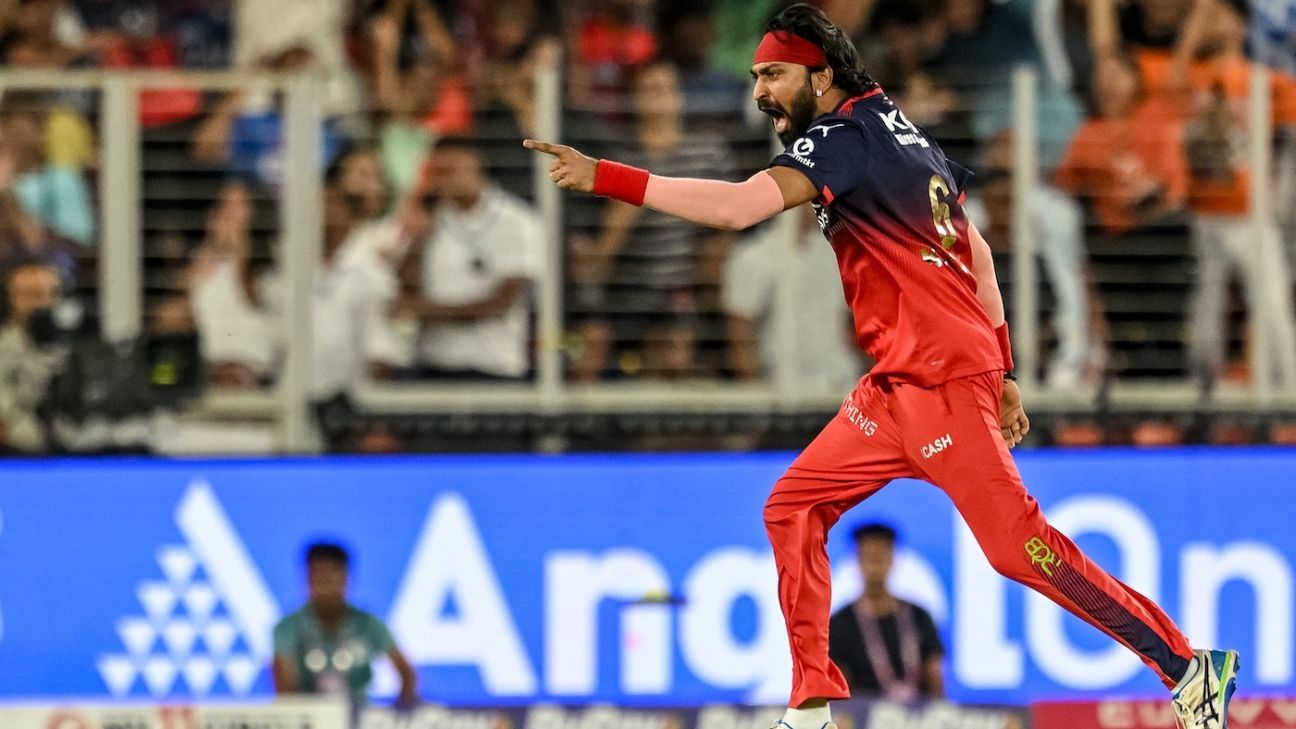
Krunal Pandya was the player of the match in the IPL opener last year. He would bookend the season with another POTM award in the final, helping Royal Challengers Bengaluru clinch their first IPL title in 18 seasons. He is the only player to be player of the match in IPL finals twice; the first time was in 2017 in Mumbai Indians' title win. The 2025 season was Krunal's best in his decade-long IPL career - he finished as best fingerspinner in the tournament and collected his personal best bowling figures. In this interview, Krunal speaks about growth, skills and his "ultimate goal".When we spoke four years ago you were released by MI ahead of the 2022 auction and you said the reason any franchise should buy you is because "Krunal Pandya is a match-winner." In IPL 2025, Krunal Pandya was a consistent match-winner - you had the best season in your ten-year career. How do you feel?Feels really good that whatever I said in 2022 has come out exactly the way I said it. After 17 years of drought, and then in the 18th season, RCB winning the trophy and me being part of it - I had a decent, tiny contribution to their success - can't ask for more than this. Going forward, I'm still hungry. I feel like this is just the beginning.There are different ways to announce yourself as a player in a new team. First match, last IPL, in the tournament opener, you bowled a bouncer to a bare-headed Venkatesh Iyer.(Laughs). I did bowl bouncers before as well, but not more than a couple in previous seasons. But this IPL [2025], I was very clear that I wanted to use that as a weapon. And it actually comes from a thought process [about] how cricket is evolving, how batsmanship overall is evolving, where the margin [of error] is so small, so as a bowler you have to keep adding new things, new varieties in your bowling and [seeing] how can you be one step ahead.So it was not that I just turned up and I bowled a bouncer. It was a very well thought-out plan that I had made getting into the IPL, where I wanted to use that ball. At the start of the season I told our spin-bowling coach Malolan [Rangarajan] that I want to get a wicket on my bouncer and that's my goal this year. And in the very first game, I had the opportunity. It's not something I planned, I just went with my gut feeling on when to bowl [the bouncer].He [Venkatesh Iyer] had played six balls and got runs. Left-hander batter, left-arm spinner, there is a match-up to go against. So first ball, I thought he'll be expecting a yorker or a slow ball, normal ball, or a length ball so I decided let me just bowl a bouncer first ball. He asked for the helmet and next ball I got his wicket. I felt like a fast bowler (laughs).That [bouncer plan] did work in my favour, but again, I was clever enough to use that. I didn't overdo it. When we were playing against MI, I was bowling to Will Jacks. [My] second over, again. That [Wankhede] wicket was flat. So I went and bowled a wide yorker [to Jacks, second ball of the over]. Again, I bowled a wide yorker third ball. And then my gut said that he's not expecting a bouncer over here, let me bowl that. I bowled a bouncer and I got that wicket where Virat [Kohli] took the catch at deep square leg. I was like, yes, I got a wicket on a bouncer, which sounds not so familiar when a spinner is bowling. If you are not one step ahead in getting into the batsman's head, then it becomes slightly difficult. Funnily, since then, I'm seeing the trend - so many spinners have started bowling bouncers, around the world, including in practice sessions.Both Venkatesh and Rinku Singh played on in that KKR match. Both were trying to hit against fast deliveries: about 101 kph and 103 kph deliveries respectively. But you were not just darting balls. Around 35% of your overall deliveries last IPL were below 90 kph and only around 12% above 100 kph. One area where you consistently outsmarted batters was the variation of speed and your lengths.Hundred per cent. That was the key factor. I did bowl a few balls in the IPL that were around 115, 118, 120 kph - the quicker balls. Against MI, where I bowled the last over of the match, I bowled one ball somewhere around 115 or 118 kph and then, in the final against Punjab Kings, I dropped the speed to 84 kph to get Prabhsimran [Singh] out. So it did help me to have that change of pace, and there was a drastic difference going from 88 kph to 110-115 kph. As a spinner, if you have that liberty to vary your pace to that margin, it does help. But what was key for me was when to bowl at what speed.Like, when I was bowling in the final to Prabh, I thought, okay, I want to bowl slow and I want to go for a wicket. And against MI, when I was bowling [at the] death, I was thinking to defend. It's not just about pace variation, it's about how you read the situation of the game as well. And according to that situation, what is required is important.During the last IPL you spoke about bowling the wide yorker and bouncer as part of your armoury. Is it fair to say you were thinking like a seamer and not a spinner, and were not shy about using these skills to your advantage?Agreed. I'll give a lot of credit to Malolan. What happens as a player is sometimes you know certain things will work for you but he gave me so much validity, and he pushed me [into] doing that. He encouraged me to bowl slow and go for wickets, to bowl the bouncer. He said if you feel like, you bowl a bouncer. He backed me and trusted my understanding of the game to that level where it was like, you do whatever you want to do, don't back [out].I'm okay with people saying, oh, he's someone who's a medium-pacer who can bowl slow and fast. But I was still a classical left-arm spinner who got wickets. Like Prabhsimran in the final - I bowled him a classical left-arm spinner's delivery, bowling slow to get that wicket. A similar wicket was Riyan Parag when we played against Rajasthan Royals, where I got him out on a slower ball that he tried to sweep.I have worked on my skillset also over a period of time, which has helped me gain that extra bounce. If you compare my action in 2020-21 to now, there is a significant change: back then I used to be [delivering from the] corner of the crease, I had a longer stride. And now I have become much taller in my action, so I have that bounce and I get some zip from the wicket. So it's not just randomly coming and bowling a bouncer or a wide yorker. When you want to bowl a bouncer, you have to be tall in your action. If your stride is too long, it's very difficult to bowl a bouncer.Also, you have to keep fitness in mind, because sometimes what happens is that you want to add new things to your [game] and your mind agrees, but your body doesn't allow it. But if you are fit enough, then your body adapts to new things much faster from a skillset point of view. To have a five-step run-up and bowl a bouncer is not an easy thing with that pace. It's a combination of a lot of things: from fitness to me working on my action to [knowing] when to bowl and when not to bowl [a certain type of delivery].Honestly, if you ask me: have I practised bowling a bouncer? I have not practised at all. I only bowl in the games. I don't practise in the nets. Do I bowl yorkers? I don't bowl in the nets. The only thing I do day in, day out with my bowling is one-stump bowling, classic left-arm spin bowling, how I can get my body behind the ball.While checking the numbers on your lengths from the last IPL, we found the most effective were the attacking good length (four to five metres from the stumps) and very short band (seven-plus metres from the stumps). You pitched nearly 24% of your deliveries on the seven-plus metre length. That was the highest among spinners last IPL. Batters were averaging 16 and striking at 144 playing balls on those lengths, but you got six wickets, including two off bouncers. It proved to be a wicket-taking delivery for you.Across my career I have been pretty consistent with my length, which has always been four to five metres. That is a length where it is neither full nor short. It's that in-between length that all spinners want to bowl: where batters can't line you up or go back. They have to play a very good shot to hit that ball.What I added to that was obviously the bouncer, which helped me massively. What I have realised in playing this format, and especially white-ball, is that the [batting] skillsets are so high. If a batter knows that you are going to bowl [a certain length and even if it's a good ball, still they will line you up and hit. But the moment batsmen start thinking what the bowler is going to bowl, if they have two thoughts, whether he will bowl this or that, then you are one step ahead. So my whole thought process regarding my bowling was: how can I create a doubt or make the batter confused about what I will bowl?I was okay being unorthodox with my planning. For example, I remember one over (13th over against Lucknow Super Giants) that I bowled to Rishabh Pant, where he scored a magnificent hundred against us. Rishabh and Mitch Marsh were batting. Now I, as a left-arm spinner, had square leg up, fine leg up, a short third, and a cover along with a deep point, deep extra-cover, long-off, long-on, deep midwicket. That's a proper fast bowler's field in death overs. I bowled a wide yorker, I bowled a wide bouncer, then I bowled a slow ball [in that over]. It was just not random changes I was doing to look cool. It was actually very well-thought out.[Before my over] Rishabh was batting at 70-80 off 30 balls [58 off 34], and I felt like I'm going to do that because I feel like he'll just line me up. I'm okay to be unorthodox. And I'm not afraid of doing something no one has done before.The next set of numbers prove how orthodox you are as a spinner: 126 out of 276 deliveries you bowled last season had dip on them. About 37% of those were dot balls and batters struggled to hit them - their strike rate was just 119. It highlights the general misconception you don't get dip, for which you have to bowl slow. Can you talk about that?People associate a lot of my bowling with me doing different things, but if you see the majority of the balls I bowled last year were classical left-arm spin deliveries. I was consistently able to get that bounce from the wicket. In the IPL wickets are flat. There's not much spin overall, so I relied a lot on bounce. Wherever there was purchase from the wicket, I was able to spin, I was able to dip the ball. Now, if you are able to dip the ball, if you are able to spin the ball, if you are able to get bounce, that means you have some sort of skillset.As a fingerspinner, because you are under pressure, you tend to bowl a lot from your shoulder, which is firing it up or slowing it. But I had worked to get my body behind the delivery. What worked for me last year was there was not much of a change in my arm speed. Even when I was bowling quick, the arm speed movement was the same, and when I was bowling slow as well, but the ball was going slow.Getting that dip is very important because it adds to the unpredictability. Incidentally, though, 12 out of the 17 wickets you got last IPL were off deliveries without a dip. That is where your defensive bowling skill sets come into play, isn't it?What happens at this level is that there is not much help through the wicket. So the only way you can get wickets or you can confuse the batter is where you stop their [bat] swing. If you keep bowling at one speed, they'll play a couple of balls and they know at this speed the ball is coming, then they can line you up. But if one is slow, one is fast, one is in between, you already have three variations. So as a batter, you don't know at what speed it is coming. So that means you are again one step ahead. So, yeah, it was a very conscious effort to have that change of pace.But again, it all depends on the situation. Like against MI, there was no variation in the last over I bowled. Everything was just 110, 115, 120 kph because the situation demanded that I not allow the batters to go for big shots. But when I bowled in the final, I constantly changed my speeds and my variations.Last year, RCB defeated Mumbai Indians at the Wankhede for the first time in ten seasons. You recorded your best IPL figures 4-0-45-4. You also bowled the final over. What was that like?Going to Wankhede, playing against Mumbai Indians, bowling that last over, winning it, and that too after ten years, was obviously icing on the cake. As a spinner bowling the last over - [Mitchell] Santner was batting, the leg side was short compared to off side, and [it was a] left-hander vs left-arm spinner. So if you see [that final over] I bowled Santner a wide yorker that I made him hit towards the longer boundary, where Tim David took a very good catch. In the same game, I had deep point behind, I had square leg up. Then second ball, I bowled to Deepak [Chahar], I bowled a bouncer. I didn't get it where I exactly wanted it but I had him caught at deep midwicket. And then I bowled Naman [Dhir] a wide yorker and he hit me for a boundary. But again, I went for the stump yorker. So I guess that entire over was a fast bowler's plan rather than a left-arm spinner's. That has been my strength: whatever is required in that situation, I try to do that because I believe that this game is about trying to do the right things more often to get the desired result.Match-ups are a key part of the T20 strategy. Usually a left-arm spinner is not used against left-arm batters. But during the DC vs RCB match in Delhi last IPL, Axar Patel came to bowl in the powerplay and got both Devdutt Padikkal and Jacob Bethell. You showed in the KKR match, where you got both Venky and Rinku, that a left-arm spinner can still hold the upper hand in the match-up. Is the traditional way of looking at match-ups changing?It is tough, but it all boils down to how much clarity you have and how much heart you have, how willing you are for the challenge. Because the batter is going to go after every ball, so you have an opportunity to take a wicket as well. The other side to that is you can get hit for a six or a four for a couple of balls and then you are under pressure bowling those remaining four balls.How much has bowling at the Wankhede helped you bowl in Bengaluru, considering both are smaller grounds?Massively. Wankhede is a red-soil wicket, so the bounce is true. The batter too finds it easy due to the good bounce. But as a spinner, if you are able to use that bounce to your advantage, you can actually hit batters slightly on the top part of the bat. Very early in my career, I realised that actually at this level, you won't be able to spin the ball. How you can beat the batter is through bounce, and that stayed with me. In fact, in my initial days when I used to go and play on black soil pitches, for example in Rajasthan, I used to find it very difficult, because I was so used to playing on flat wickets where there is bounce. Over a period of time, though, I understood what works on black soil and what works on red soil. At Chinnaswamy, it's a black-soil wicket, but there is some amount of bounce as well as a tiny bit of spin if you have the skillset.In terms of the ground size, if you as a bowler, before getting into your spell, think that, oh, this ground is so small, it's so tough, you have already lost the battle. So I tell myself that if I execute my skill then if the boundary is 40 or 50 or 60 or 70 metres, he [the batter] won't be able to hit me. And if I'm not able to execute my skill, then anyways whether it's 80 metres or 60 metres, it is going to go out. It's important to not think about all of this because you can't change it. So how can you narrow down your focus and bowl good balls where you know that if I bowl good ball, it won't move more than 30 yards.While you might call yourself a bowling allrounder, it is difficult to summarise your role from the outside. In bowling you don't really finish your overs and as a batter you will always come up with handy cameos. However, in the last IPL you undeniably proved you are a match-winner, which matters in the end for teams. What does it take to be that kind of a player when you are not a specialist in either role?With all gratitude, respect and humility towards everyone's point of view, eventually, what you think about yourself is very important. I feel like I'll take it as a compliment that I am the only player who is so flexible that I can bowl in any situation, who can do all the difficult things for the team, whether it is with the ball or bat. I have played like that, I've always prepared like that, because if you follow my career, I have always done the things a team requires in that particular situation. And that has been a reason why I have been able to contribute massively in victories.I know that on a given day with the ball, I can win games. On a given day, I can win games with my bat. On a given day, I can win games with my fielding. Because as you said, over a period of time, people think I'm [neither] a proper bowler or a batter, but to play for ten years, to be part of four IPL trophies, and to have [made] a significant contribution, that itself shows that there's much more beyond just being a batter or a bowler. There is a package.I'll take you to the 2019 IPL final where I bowled an over to [Shane] Watson, in which he hit me for three sixes. In the final over [bowled by Lasith Malinga], I was standing at deep extra cover, and I was the one who got him [Watson] run out. You just have to fight and make sure that that win comes your way.



Most Popular