
“I was already at war in the summer”: Deniz Undav opens up about his frustration over his creative slump and Klopp’s rejection
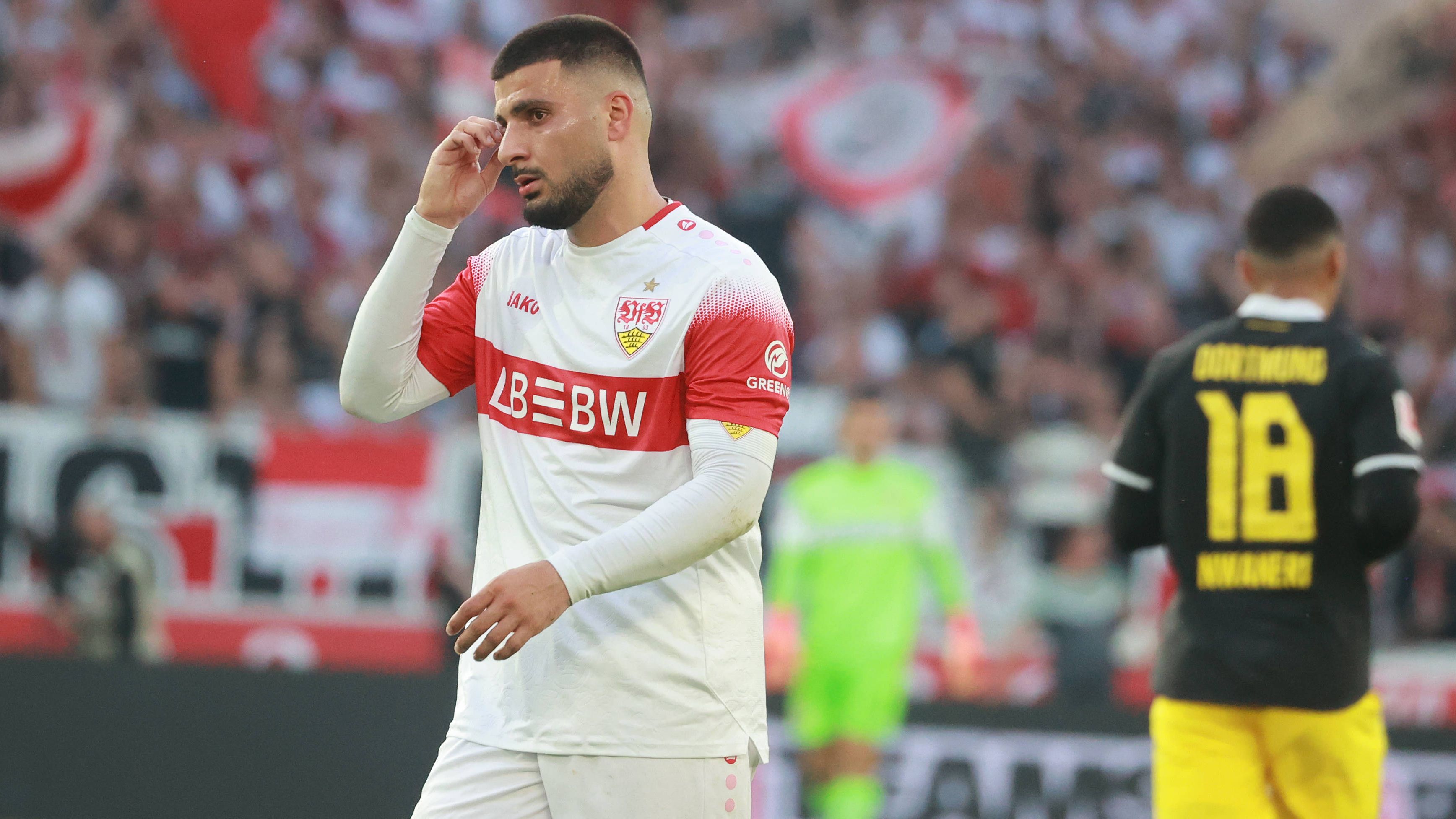
Deniz Undav shook his head when his game against Borussia Dortmund ended after 63 minutes. He made his way slowly to the bench, briefly high-fived Dzenan Pejcinovic and walked behind Sebastian Hoeneß towards the dugout. He glanced at the coach, who was shouting instructions onto the pitch and did not see him. Undav kept trudging on, his shoulders now drooping slightly forward, dutifully high-fived the people he passed, grabbed a drinks bottle and sat down on the bench.A few minutes later, he could only watch helplessly as Dortmund, with their second shot on target and after their first genuinely successful combination through Nico Schlotterbeck, Jobe Bellingham, Konstantinos Karetsas, Bellingham again and finisher Maximilian Beier, went 1-0 up in this rather laboured game.By around 30 minutes later, VfB had suffered their third defeat in their fourth Bundesliga game of the season. Undav, with 0 goals this season, 0 assists, 0.5 shots and 24.8 touches per game, then analysed his team’s poor start to the season in general and his own in particular on Sky, talking his frustration out of his system in the process."I feel like I’m too far back on the pitch. I’m too far back, then I have to run 40 metres forward and I don’t get any balls there. I’ve only had two chances in four games," he said. Last season, he said, he had "held the line more and then been there at the right moment."IMAGOWho is responsible for Deniz Undav’s weak start to the season?Anyone expecting not exactly subtle criticism of his coach Sebastian Hoeneß is mistaken. Hoeneß has not changed Undav’s position at VfB, nor is he asking anything different of him than he did last season. Sebastian Hoeneß knows that is only possible to a very limited extent.Deniz Undav’s greatest strength, and plenty has been written in recent years about his improbable football career, is that he is not one of those modern, remotely controllable footballers who have had every possible and impossible run for every possible and impossible situation drilled into them at academy level.His coaches can, of course, teach him things and give him tactical concepts. They can tell him which spaces they would prefer him to occupy and how, for example, he should work back defensively. Undav is still a professional footballer, albeit one who took the scenic route. His career is not based on chance.Try to map out his runs, though, and it would not work. That is simply not how his game functions. Undav is not a "template footballer", but "an absolutely brutal instinctive footballer. He associated the game unbelievably well. He already knew what would happen on the pitch three steps later," two of his former youth coaches explained about player Deniz Undav in Spiegel during the World Cup.That was when Undav had managed three goals and one assist in the first two group games against Curacao and above all against Ivory Coast, and it felt as though the whole of Germany had embraced Deniz Undav and his improbable rise (still a third-division striker six years ago, and a little before that living on 100 euros a month, with 17-hour days between work and training and a 40-minute walk to work).For a few days, Deniz Undav, this likeable north German with Kurdish roots who "has to eat a kebab or burger once or twice a week" for his peace of mind, seemed like the type who could bring Germany’s good mood back. For a very brief moment, everything really did seem possible, even that Undav could fire Germany to the World Cup title.Even Julian Nagelsmann started him in the round of 32 against Paraguay.IMAGOWhat did Julian Nagelsmann say about Undav after the World Cup exit?After the elimination on penalties, Nagelsmann publicly criticised only one player, Undav. Or rather, one missed chance by Undav in the early stages of the match. "There are four of us standing alone in front of goal there, we only have to square it and then we tap the ball into the empty net. But Deniz somehow chips it to the far post. It’s a very simple action, there wasn’t much to it," said Nagelsmann.The sentence stayed with Undav throughout the summer, even though he is actually characterised by a certain couldn’t-care-less mentality. "I kept thinking the whole time about whether our elimination was also my fault," Undav said before the start of the season in Bundesliga-Magazin.He said he had not seen a team-mate in a better position in that situation, and there had still been 115 minutes after the missed chance to avoid the penalty shootout. Even so, he kept asking himself the question: "Was it really my fault?"Of course it was not. Of course no one can know, except perhaps Undav himself, whether that missed chance, including Nagelsmann’s final swipe, is still affecting the 30-year-old today.Why did Jürgen Klopp not nominate Deniz Undav for the Germany team?The fact is that Undav currently has to deal with several professional setbacks that had seemed unthinkable before the World Cup. That was when everything seemed to come easily to him, when he managed 19 goals and six assists in the Bundesliga and nine goals and two assists in 13 internationals. Then came the crisis with VfB Stuttgart, his personal goal drought and, on top of that, Jürgen Klopp initially leaving him out of the rebuilding of the Germany team after the World Cup debacle."Now I have to prove to a coach all over again that I belong,” Undav said on Sky. That is "exhausting", he said, before clarifying: "He said expectations are different. In the two games he saw, against Bayern and Cologne, I wasn’t good. You have to accept that. I was briefly disappointed because I thought that through the World Cup and the games in the national shirt I might have built up a bit of a buffer. That apparently isn’t the case. I have to prove myself again and show the coach once more that I belong. It is exhausting to have to prove that to every coach, but I’ve done that often enough. I’m not one to wallow, I’m not going to cry about it now. I was disappointed for five minutes and after that I looked forward. I will give everything to put myself forward in November."Deniz Undav is defined by an “I don’t give a damn, I’ll do it” mentalityAsked what he meant by saying he was not one to wallow, another rather unique facet of him flashed up. "I speak openly, I don’t mince my words and I say what I think, negative or positive. I’ve often had problems and often had to prove myself. That’s been the case all my life. No matter where I was, at the beginning it didn’t work because people said my body language wasn’t right or I wasn’t a sprinter. But it’s been like that all my life. I had 39 goal involvements last year and my body language was the same. If you know me as a person, you know how to deal with that."There it was again, that "I don’t give a damn, I’ll do it" attitude that makes up a large part of his aura. If he rediscovers that on the pitch as well, there is probably no need to worry too much about the rest of Deniz Undav’s career path.

.png)

Most Popular



West Indies squad for India tour announced
13 hours ago


Cowboys shut out Racers
12 hours ago