FIFA World Cup 2026: Ibrahim Mbaye, the 18-year-old PSG star who turned Senegal's stoppage-time goal into history
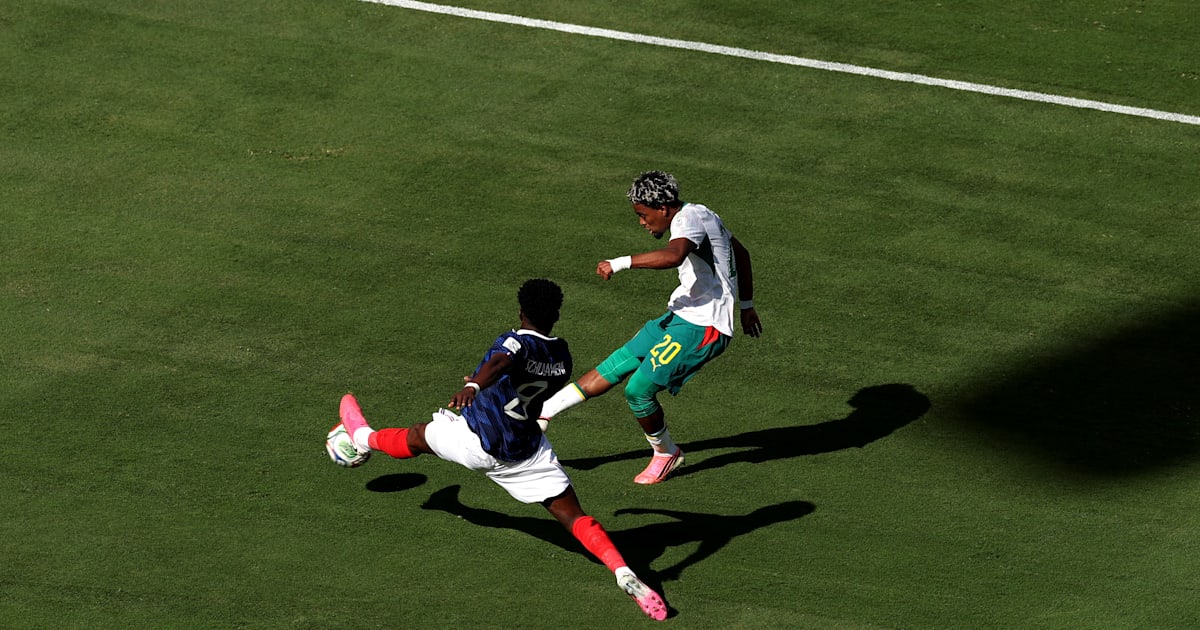
There is a version of 16 June 2026 that never makes the highlight reel.France 3, Senegal 0, eighty-five minutes gone, and a teenager rises off the bench at MetLife Stadium in a seemingly impossible situation for the losing team. But Ibrahim Mbaye does not play like a man making up the numbers.The Paris Saint-Germain player picks the ball up wide right, sends Théo Hernandez the wrong way with a feint and a roll of the foot, and drills a shot past French keeper Mike Maignan into the goal. Stoppage time, minute 95, France 3, Senegal 1. The scoreline says defeat, but the record books say something else entirely.At 18 years and 143 days old, Mbaye became the youngest African to ever score at a FIFA World Cup, eclipsing a mark held by his own countryman, Moussa Wagué in 2018. Zoom out further, and the company gets serious: only Pelé, Mexico’s Manuel Rosas, Spain’s Gavi and Lamine Yamal have scored at a younger age in the tournament’s history.C’est du sérieux. This is serious business, and Mbaye has been doing serious business since long before MetLife Stadium ever learned his name.Books before Ballon d’OrWind back ten months. PSG’s squad boarded a flight to Marseille for a Ligue 1 fixture; Mbaye, then 17, was not on it. He was sitting his baccalauréat, the qualification every French teenager must clear before the country considers them properly educated. The club arranged for him to travel separately, and he joined the team in time for an 8pm kick-off, having spent the afternoon solving equations rather than warming up.It would have been the defining anecdote of most careers. For Mbaye, it was simply Tuesday.The PSG Academy, the production line that has already delivered Warren Zaïre-Emery and Senny Mayulu to the first team, treats the classroom with the same seriousness as the training pitch — academy director Yohan Cabaye points to a 95 per cent baccalaureate pass rate among the club’s young players, insisting academic discipline is inseparable from footballing development.In Mbaye, that theory has found its most compelling advertisement yet. The nutmeg-and-finish against France was not improvisation, but a problem solved in real time, the kind of unhurried execution you would expect from someone who treats an exam hall and a 95th-minute World Cup chance with identical calm.Mbaye's chooses Senegal over FranceMbaye was born in Trappes, a Paris suburb better known for producing Nicolas Anelka than international intrigue. His father is Senegalese, his mother Moroccan, and his footballing education ran entirely through France’s youth ranks — a player good enough that Les Bleus never seriously doubted he would represent another nation.However, in November 2025, Mbaye chose Senegal.It was not a decision taken under duress. The call was his alone to make. “I will never regret choosing to play for Senegal because it was a decision from the heart,” he told Senegalese broadcaster RTS after lifting the Africa Cup of Nations trophy in January, a tournament he navigated as a teenager among senior pros twice his age. Months later, reflecting on the choice again, he was even more direct: “If only you knew… it’s the best decision I’ve ever made in my life. The Senegalese have such huge hearts; it’s incredible.”That is why the France match landed the way it did. A boy raised in the Paris suburbs, schooled in the country’s most storied academy, scoring his first World Cup goal against the very nation that shaped him — wearing the green of Senegal as he did it. Quelle histoire. Scriptwriters would have rejected it as too neat.Ibrahim Mbaye's meteoric rise: the numbersMbaye’s rise reads like a player years beyond his age. He made his Ligue 1 debut at 16 years, 6 months and 23 days, becoming PSG’s youngest-ever league starter, a record previously held by Zaïre-Emery. He signed his first professional contract in February 2025, scored his maiden senior goal weeks later, and by August had become the youngest Frenchman to feature in a UEFA Super Cup, overtaking a mark set by Ryan Giggs in 1987. In May 2026, his stoppage-time strike away at Lens sealed PSG’s 14th Ligue 1 title.For Senegal, his timeline is just as impressive: a debut against Brazil in November 2025, a goal three days later on his second cap, then the youngest player ever to feature at the Africa Cup of Nations in December, before he broke his own record as the nation’s youngest-ever AFCON goalscorer in January — en route to lifting the trophy before CAF ruled to award the victory to Morocco after the match. In any case, four goals in twelve caps before his nineteenth birthday need little further dressing up, and comparisons with Kylian Mbappé appear justified.What stands out most to those who coach him, though, is his decision-making — knowing when to carry the ball and when to release it, advanced well beyond his minutes on the pitch. That, again, is the discipline talking. Mbaye does not need twenty touches to make an impression. He needs one.“Mbaye is world class, and he is ours, he did not choose France – he chose Gaindeyi,” Wahany Johnson Sambou, a Senegalese journalist, told Olympics.com in January, referencing the popular Wolof language name for the national team. “He’ll do great things, just watch.”Looking to LA 2028, by Way of Dakar 2026 Youth Olympic GamesSenegal’s relationship with Olympic football is still being written. The nation has competed in the men’s tournament only once, at London 2012, the Games that launched future stars Sadio Mané, Idrissa Gueye, and Cheikhou Kouyaté. Senegal have not returned since.But with the eyes of the sporting world about to fall on Senegalese soil when Dakar hosts the Youth Olympic Games this October, there is a sense that this is a country whose Olympic moment, including in football, as arrived.Mbaye, born in January 2008, will be 20 when LA 2028 arrives: precisely the window for an Under-23 tournament that has launched Messi, Neymar and Mohamed Salah before him. Olympics.com has already flagged him among the continent’s brightest prospects for the Games, and it is not hard to see why.What makes the prospect of Mbaye at LA28 so compelling is not simply his already impressive trophy cabinet but the temperament behind it — the same unflustered clarity that got him through a baccalauréat exam on a matchday morning and helped him deliver in the unforgiving 95th minute of a World Cup opener.For now, though, Mbaye is simply doing what he has always done — quietly, calmly, and ahead of schedule: turning up early to a moment everyone else thought was still years away.Don’t keep your eyes off this gem.


Most Popular