In a World Cup of chaos, France look unstoppable

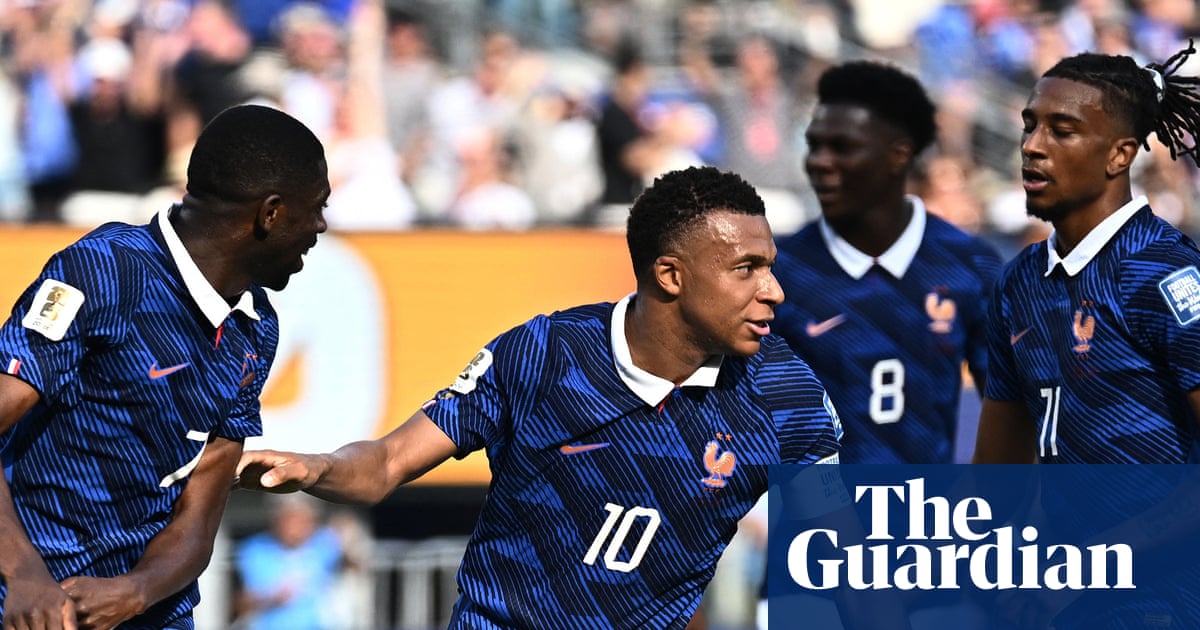
During the first knockout games of the FIFA World Cup, games have been decided in chaos, often by the most slender of margins.Brazil, Canada and Norway all required extremely late goals to maintain their places in the competition. Morocco and Paraguay both needed penalty kicks, the harshest means of breaking a deadlock.And then came France, the most fancied team of all, emerging from the bedlam to remind us all that football games can be won with order, serenity and utter dominance.France entered this competition as favourites and this perception has only consolidated since the tournament began three weeks ago. The French performance in the group stage, winning all three games, was matched only by Argentina and Mexico. A goals haul of 10 was equalled only by the Netherlands and Germany, both of whom have now gone out.This France performance was their most menacing yet, a devastating dismantling of a Swedish team which included seven regular Premier League players in its starting XI. It featured two more goals from Kylian Mbappe, who has now scored more World Cup knockout goals than any player in the competition’s history, and it ended with his coach, Didier Deschamps appearing to bow down before his striker. France had 25 shots on Sweden’s goal, 12 of them on target.Sweden, it should be said, were amenable opponents. The setup by coach Graham Potter, offering two lines of four in midfield and defence, gave the freedom of New Jersey to Michael Olise, France’s utterly irresistible playmaker. Surrounded by the speed and guile of Ousmane Dembele on the right side, Bradley Barcola on the left, and then the sheer electricity of Mbappe through the middle, Olise treated MetLife Stadium as his personal playground.He played short and long, around the corner here, through the legs there. He collected the ball from the centre-backs to begin French attacks, but then he popped up just about everywhere on the field. He turned up on the left, then right, then in behind the Swedish midfield and sometimes beyond his own frontmen. By the end, his touchmap resembled a toddler’s first encounter with painting, splodges here, there and everywhere.Thierry Henry, a French icon in his own right, provided the best description for the Olise-Mbappe relationship after France’s opening game win over Senegal. “If Mbappe is France’s MVP, then Olise is their MIP — Most Important Player,” Henry said.Henry, who previously coached Olise at the 2024 Olympics, continued his praise for Olise in the Fox studio on Tuesday night. “Michael is a freak. The way he sees stuff is not the same way as others. Sometimes he was doing stuff in training and you need to hold yourself back because you’re just thinking, ‘Wow!’ This guy is on another planet.”Olise’s was a pitch perfect recital, but the supporting cast were not far behind. Desire Doue had appeared to be Deschamps’ preferred choice on the left flank, starting against Senegal and Norway, but he was replaced by his club team-mate Bradley Barcola for this game. At one point, Barcola sat two Swedish defenders down on the floor with one perfectly timed change of direction. Barcola scored the second goal, applying a brutal finish to Olise’s sublime pass, once again teased through the legs of a toiling Swede.“The other ones are killers,” said Zlatan Ibrahimovic on Fox. “But Olise sees solutions that only a genius sees.”Olise, Barcola and Doue are aged 24, 23 and 21, and their emergence for this World Cup is part of what Deschamps describes as the “oxygenation” of his French team, breathing fresh life into a squad that reached the final but lost on penalties against Argentina in Qatar. Hugo Lloris, Raphael Varane, Antoine Griezmann and Olivier Giroud have all departed the starting line-up since the 2022 final in Doha. They have been replaced not only in terms of quality but also in the sheer quantity of options.Olise’s brilliance is such that the absence of Rayan Cherki, one of the breakout stars of the Premier League at Manchester City last season, has so far been reduced to a footnote, yet as the tournament rolls on, it is daunting to know that Deschamps could yet pull that ace from his pack.“They rotate with a lot of players,” said Sweden and Arsenal forward Viktor Gyokeres. “They are not static, they know each other well in their connection, so when they have quality and movement, it’s going to be tough.”Predictions in knockout football are dangerous. Football is a game that can be disturbed by the finest of margins; a refereeing decision, an unexpected injury. We are yet to see how France may respond should they fall behind and their greatest threat may come from within, should complacency undermine the obvious talent in their ranks. But it is difficult to make a case, at this stage, for a rival that has the blend of power, speed, balance and skill to overcome Deschamps’ side.This is a nation powered, too, by vengeance, seeking to win back the World Cup after their disappointment in 2022. There is also palpable desire to give Deschamps a perfect farewell, underlined when Mbappe ran to the touchline to embrace his coach as Deschamps returned to the competition after taking a few days away to grieve the passing of his mother.“I personally have not seen a better team,” said Potter, who claimed his Swedish side could have been perfect on the day but still lost the game, such is the French supremacy at this tournament.On British television, the former France World Cup winner Patrick Vieira even suggested this generation is as good, if not better, than his own title-winning team from 1998, which included Zinedine Zidane. The 25 shots recorded by France against Sweden were the most a French team has registered since the 37 against Paraguay in the round of 16 in 1998.France’s route to the final now moves into view. In a tournament which poses major questions to some nations, traversing borders and altitude, the schedule has been kind to France. If they make the final at MetLife Stadium on July 19, they will have played seven of eight games in the north-east corridor of New Jersey, Philadelphia and Boston, exiting only for a possible semi-final in Dallas. They will also be familiar with the MetLife field, having played here twice already.France will now face Paraguay in Philadelphia on Saturday, before taking on the winner of Morocco against Canada in the quarter-final in Boston. In the semi-final, their possible opponents would include Spain, Portugal, Croatia, Belgium or the United States. They cannot face Brazil, Argentina or England until the final.“I can’t remember the last time we watched a team where a team is so dominant from the off,” said former England international Ian Wright to UK broadcaster ITV. “You look at them and think ‘Who is going to stop them?'”


Most Popular