Zimbabwean breakout at T20 World Cup has fans rejoicing renaissance
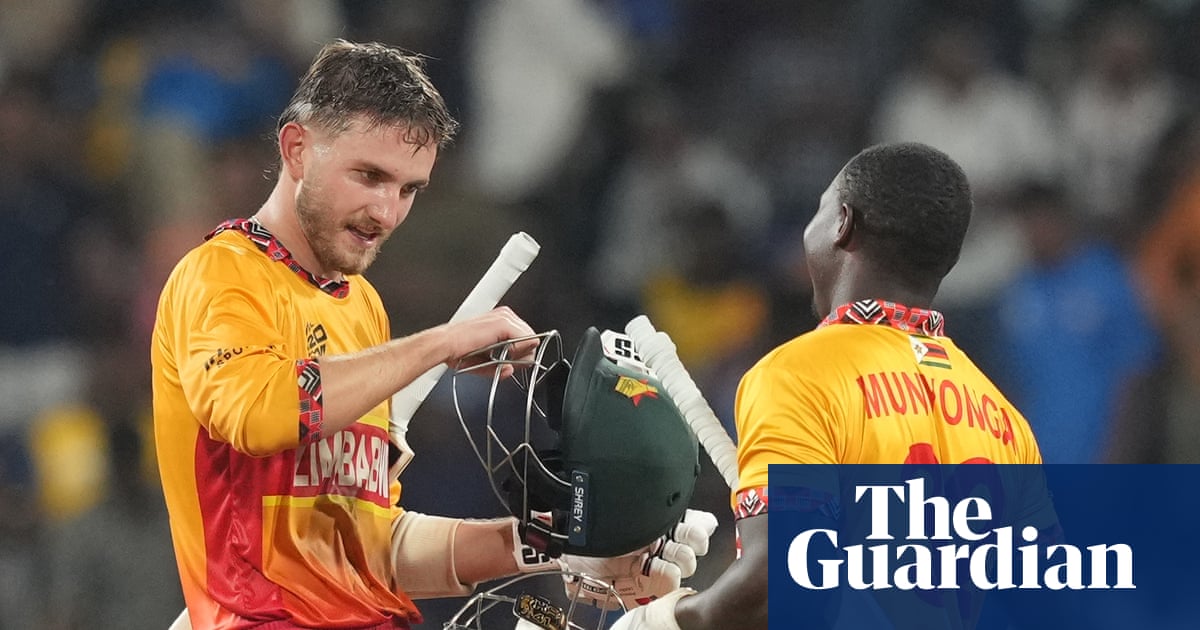
Dean du Plessis could tell that Zimbabwean cricket had turned a corner by the noise of the crowd. The veteran broadcaster, who was born blind, has forged a remarkable career as a commentator by distinguishing the game’s almost imperceptible audio shifts. He can tell a slower ball has been bowled by the fractional delay before ball meets bat. He can tell if a batter has pressed forward or back by the scratch of spikes against the hard pitch. And he could tell, in 2018, that the sport he loved would never be the same again.“When I was a teenager, cricket in Zimbabwe was almost exclusively played and supported by white people,” Du Plessis says. “And besides the accents and topics of conversation, you could tell this by the way they would applaud and chant. It had a particular energy. The most animated fans were usually the ones who had too much beer and hurled abuse at the players on the boundary.”In the late 1990s, that ecosystem produced a golden generation. Andy Flower rose to the top of the ICC’s Test batting rankings. Heath Streak carried the attack. Zimbabwe beat South Africa at the 1999 World Cup en route to the Super Sixes. They were plucky, precise and competitive. But they were also almost monochrome. So were their fans. Cricket was seemingly out of step with a country that shed so much blood to reimagine itself after colonial rule.“I think this truly changed during the World Cup qualifiers in 2018. I can’t remember who they were playing, but I remember that the crowd was chanting in Shona. You could tell that people were dancing as they sang. It felt like this team was finally getting the love of the majority of the country. It feels like cricket is now a sport for everyone.”That swelling fanbase has been in dreamland this past month as Zimbabwe have defied expectations in the ongoing T20 World Cup. Having taken the long road to qualify, playing Rwanda, Seychelles and Gambia, they arrived in the sub-continent and beat Australia by 23 runs and Sri Lanka by six wickets to top their group and qualify for the Super Eights.It was only seven years ago that Zimbabwe failed to qualify for the 2019 World Cup in England. Du Plessis remembers the stunned silence when the team lost to the United Arab Emirates in Harare, but the thunk of hitting rock bottom would come five years later. In the space of five months in 2023, the Chevrons missed out on qualification for both the 50-over World Cup and the expanded T20 World Cup in America and the Caribbean in 2024, losing to Uganda in what has been described as a nadir for Zimbabwean cricket.Throughout, Du Plessis remained hopeful. “All Zimbabweans are able to hold optimism and pessimism in their hearts at the same time,” he says. “You never fully accept that things will come right for good. But you also never fully lose hope.” “All Zimbabweans are able to hold optimism and pessimism in their hearts at the same time,” he says, briefly touching on the nation’s turbulent history. “You never fully accept that things will come right for good. But you also never fully lose hope. Without that optimism, we’d all sink into despair.”Hope alone, though, does not win T20 matches. Players need space to develop both their skills and a sense of togetherness. Between the defeat by Uganda and this World Cup, Zimbabwe played 55 T20 internationals, more than New Zealand (51), South Africa (46), Australia (43) and England (40).They’ve also resisted wholesale change. “We got Zimbabwe in this mess,” captain Sikandar Raza, who led the team against Uganda, recently told Cricinfo. “So to take Zimbabwe to new cricketing heights, it’s our job.” Along with Raza, who provides all-round nous, five players who were part of their nation’s biggest embarrassment have helped turn things around. Wicket-keeper and opening batter Tadiwanashe Marumani has been emboldened to be more aggressive against the new ball, Ryan Burl gives it a thwack in the middle order, and, as the spearhead of the attack, the 6ft 8in Blessing Muzarabani has flourished, snaring 11 wickets in the tournament at a miserly average of 10.27.This core group has been well supported by faces new and old. At the top of the order, 22-year-old Brian Bennett has been a revelation, registering unbeaten scores of 48, 64 and 63 before he was finally dismissed by the West Indies for five. Meanwhile, 39-year-old Graeme Cremer has returned after a seven-year hiatus to deliver leg-spin in the middle overs.After the win over Sri Lanka, which secured top spot in the preliminary round of the World Cup, a group of travelling fans known as Castle Corner were invited into the players’ dressing room to share in the celebrations. “We know them on a personal level,” Raza explained. “Our relationship runs very deep. We know them, their families, their jobs, wives, kids.“We sat and said thank you to them. It’s a two-way street now, because our fans have started a new tradition of travelling by spending from their own pocket.”Zimbabwe will host the Under-19 World Cup later this year and will share the 2027 men’s 50-over World Cup with South Africa and Namibia. There are signs that Zimbabwe is on the rise, but Du Plessis knows not to confuse momentum with permanence.“We’ve been through too much to ever relax. But maybe that’s a good thing. Hopefully that means we won’t be complacent. It’s great to feel something other than shame for this team. I hope that this can catapult them forward.”For years, Zimbabwean cricket lurched between chaotic noise and indifferent silence. Now, even after heavy defeats, like the 107-run pasting handed out by the West Indies on Monday, the singing continues. As Du Plessis believes, change is often heard before it is seen.


Most Popular