Trump’s college sports roundtable: Two hours of talk, with few solutions

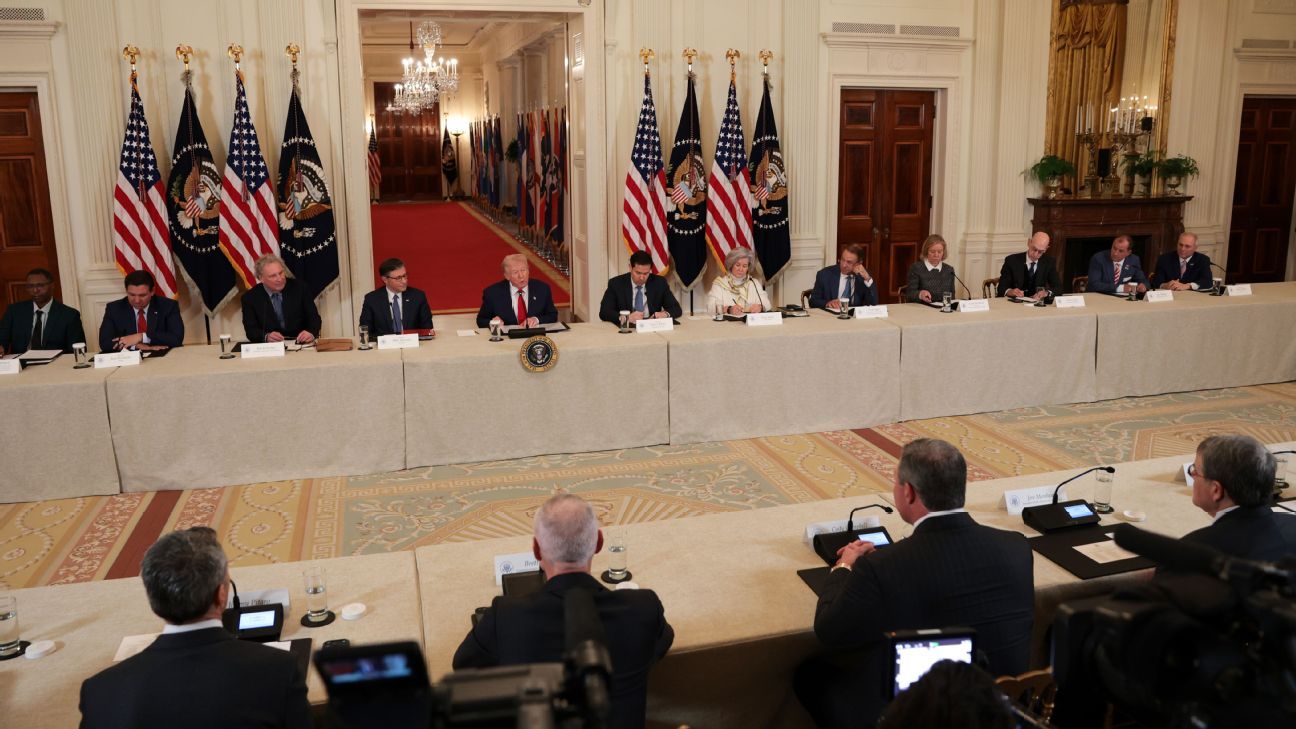
WASHINGTON — A White House roundtable spent nearly two hours discussing the future of college athletics on Friday afternoon, led by President Donald Trump and featuring the most prominent political and college sports leaders in the country.The meeting started with repeated acknowledgement of the many challenges facing the industry and ended with a frustrated Trump railing against Senate Democrats and the court system. Trump also promised to produce an executive order in the next week “because that’s the only way this is going to be solved.”“So I’m going to sit down, and I’m going to write an executive order based on many of the sentiments made (Friday), many of the sentiments I’ve been hearing over the last year about what a disaster this is for colleges, the players, the families, ruining families, ruining everything,” he said.There was also discussion of reviving the SCORE Act (Student Compensation and Opportunity through Rights and Endorsements), a bipartisan-drafted bill that’s currently paused in the House of Representatives but could represent the best available starting point for college sports reform through federal legislation. The bill, as currently drafted, would replace the patchwork of state name, image and likeness laws with a national framework while giving the NCAA limited antitrust protection.Trump chaired the event, which hosted more than 50 people from politics, business, and college and professional sports in the East Room of the White House, seated around a massive rectangular collection of tables. Secretary of State Marco Rubio, Florida Gov. Ron DeSantis and New York Yankees president Randy Levine served as vice chairs, with Speaker of the House Mike Johnson and Senator Ted Cruz also in attendance. NCAA president Charlie Baker was there along with several conference commissioners, university athletic directors and presidents. Former college football coaches Nick Saban and Urban Meyer attended, as did NBA commissioner Adam Silver. Representative Lori Trahan, a Democrat from Massachusetts, was the only elected Democrat featured.There were no current college athletes in attendance, though multiple speakers, including Levine, stressed that they would be consulted and included in the process moving forward.The roundtable reiterated the need for large-scale reform in college sports, likely via Congressional antitrust exemptions and bipartisan legislation. The added financial strain of the House v. NCAA settlement and direct revenue sharing with athletes — adding over $20 million to the annual budget for most power-conference schools — has caused an economic crisis for many athletic departments. That threatens funding for Olympic and non-revenue sports, plus smaller programs.The event also reinforced how difficult it will be to reach those solutions, which led to Trump gathering this panel in the first place. The question is whether this event, which featured a lot of emotion, grandstanding and saber-rattling — at times from secondary and tertiary characters who did not sound fully informed on the issues — brings college sports any closer to a solution. The answer probably depends on the fate of the SCORE Act and whether the calls for compromise and bipartisan action come to fruition.In a joint statement, Big Four commissioners Jim Phillips (ACC), Greg Sankey (SEC), Tony Pettitti (Big Ten) and Brett Yormark (Big 12) thanked Trump, calling the event “an important step,” and saying, “Federal action on college sports is long overdue, and we stand with a broad coalition of conferences, student-athletes, coaches, and advocates in supporting the SCORE Act. We look forward to working with both President Trump and Congress to enact meaningful reform for student-athletes across the country.”Here are the highlights …Trump’s frustration and (another) Executive OrderTrump’s announcement that he would sign an executive order “within a week” with input from several in the room (Trump singled out Saban and Levine in particular) was a result of his frustration with hearing about the challenges of passing legislation through Congress and the way past court decisions have reshaped college sports.“You have a lot of Democrats in the Senate that I hear are opposed to almost anything,” Trump said.Yet an executive order can’t make a law, provide antitrust exemptions or override state laws, and any policies in the executive order can be challenged in court — a reality that Trump repeatedly acknowledged on Friday as well.“Let’s see if we can get it through the court system, which we might not be able to do,” he said.We’ve already seen a version of this last July, when Trump signed an executive order titled “Saving College Sports” that was also aimed at addressing the industry’s many issues, but produced no binding changes.Asked how a new order would be different than that one, Trump responded: “It will be more comprehensive.”The likely truth is that an executive order solves very little, if anything. What was most notable about Trump defaulting to that option is that it illustrated his frustration — in college sports and otherwise — with Congressional Democrats and the court system.Future of the SCORE ActAmid the spectacle of a televised roundtable, the most pertinent news regarding the fate of college sports was Speaker Johnson stating that the SCORE Act may finally be on the verge of a vote in the House of Representatives.“We are right on the verge of passage in the House, and we now think we have the votes to do that,” he said Friday.There seemed to be a tepid consensus in the room to treat the SCORE Act as a basis moving forward, rather than starting from scratch with new legislation.Here’s why that could be significant.Last summer, the SCORE Act passed through committee markup in the House of Representatives, a stage that no comprehensive college sports bill had reached before. It’s a bipartisan bill driven largely by Republican support that checks many of the most important boxes college sports leadership has been requesting from federal legislation: a limited antitrust exemption to provide protection from lawsuits; preemption of varying state laws, particularly regarding athlete compensation; and preventing college athletes from becoming employees.“It was good to hear so many speakers advocate for the SCORE Act, which does address many of the issues that cause both uncertainty and confusion for just about all of us in college sports these days,” Baker later told The Athletic. “The chance for us to engage with one another informally beforehand and afterward was also a real bonus. Everybody appreciated the President’s decision to get us together, given the urgency of the issues we were discussing.”The SCORE Act does not solve or address every issue, including the economic strain many universities feel, but it would codify the House v. NCAA settlement and provide some stability.However, it has faced considerable opposition, especially from Senate Democrats and those who want stronger protections and representation for college athletes regarding compensation, benefits and potential for employment status.Even those who support the SCORE Act acknowledge that it faces an uphill battle in the Senate, something Sen. Cruz stated on Friday.“The SCORE Act has many good elements, it’s a very good first step,” said Cruz. “But the challenge is for this to be passed into law and put on (the president’s) desk, we need 60 votes in the Senate, which means we need at least seven Senate Democrats (to support it). Right now there are zero.”The SCORE Act faces major hurdles. Yet many believe that passing the House at least signals momentum and could be an impetus for the Senate to work toward something, even if it requires more change and compromise.“The influence of all the people around this table could help us get some of those critical Democratic votes in the Senate,” Cruz said.The bigger fear is that if the bill can’t even make it through the House, it’s back to square one.History of court decisions impacting college sportsThis new era of college sports — with athlete compensation, unlimited transfers and all the unregulated chaos that has come with it — is mostly a result of court decisions against the NCAA in recent years.One was the NCAA v. Alston case in 2021, in which a historically divided Supreme Court ruled unanimously against the NCAA, voting 9-0 to uphold a lower court decision that stated the NCAA cannot limit education-related payments to student-athletes due to federal antitrust principles. It set the stage for the NCAA to remove restrictions on college athletes earning NIL money. It also influenced the House v. NCAA settlement last summer, which resolved a trio of additional antitrust lawsuits against the NCAA and power conferences and allowed schools to pay athletes directly, essentially undoing the amateurism model in place for more than a century.Trump mentioned multiple times during the roundtable his preference to go back to the system “we had before” in college sports, when athletes were given scholarships but couldn’t earn money outside of that. He blamed the new reality on a “radical left judge from California,” seemingly referencing Judge Claudia Wilken of the Northern District of California, who ruled in the Alston case and presided over the House settlement.The president was eventually informed on Friday that the Alston decision had been appealed to the Supreme Court.“So the Supreme Court was responsible for this? Gee, that surprises me,” Trump said, sarcastically. He later added, “The Supreme Court ought to be ashamed of itself for a lot of reasons.”A sense of urgency to do somethingMany in attendance have a sense of urgency that something needs to be done as soon as possible, ideally before the next academic year, as budget demands continue to intensify.One potential financial solution that has caused division within college sports is pooling television rights together across the entire sport of college football, similar to how the NBA and NFL operate, rather than individual conferences signing television contracts. Doing so would require getting the SEC and Big Ten on board, as well as amending the Sports Broadcasting Act.After the roundtable, two senators announced a bipartisan proposal to do just that. The discussion draft released Friday by Eric Schmitt (R-Mo.) and Maria Cantwell (D-Wash.) would provide an antitrust exemption for schools and conferences to sell their media rights together. A 14-person committee would oversee the sale and distribution of those rights. Schmitt and Cantwell said in a statement that they’ll introduce their legislation — called the College Sports Competitiveness Act — in the Senate next week.Smash Sports, a subsidiary of private equity firm Smash Capital, has also been lobbying universities and lawmakers in Washington on the idea.Trump was also asked more specifically about the timing of the roundtable amid a war in Iran and other current events.“In Iran we’re doing very well,” said Trump. “I saw what was happening with college sports, and it doesn’t sound very important compared to what’s happening in Iran and other places, but it is very important to me. And if I can get it done, I’ll get it done.”Final thoughtsIf nothing else, Friday’s roundtable summarized the headwinds college sports are confronting and the various self-interests, egos and competing voices that make solutions so hard to come by.Another executive order is unlikely to have a significant, lasting impact. The SCORE Act has already been trapped in purgatory for months, with no apparent backup plan.Will the roundtable make a difference? There’s a chance that Trump’s public frustration makes bipartisan legislation even tougher to accomplish. Or maybe the added attention could spark that necessary urgency and encourage compromise.Either way, the meeting raised far more questions than answers.

)

Most Popular