
Grass season is back, and tennis stars are in a race against time on the slipperiest surface

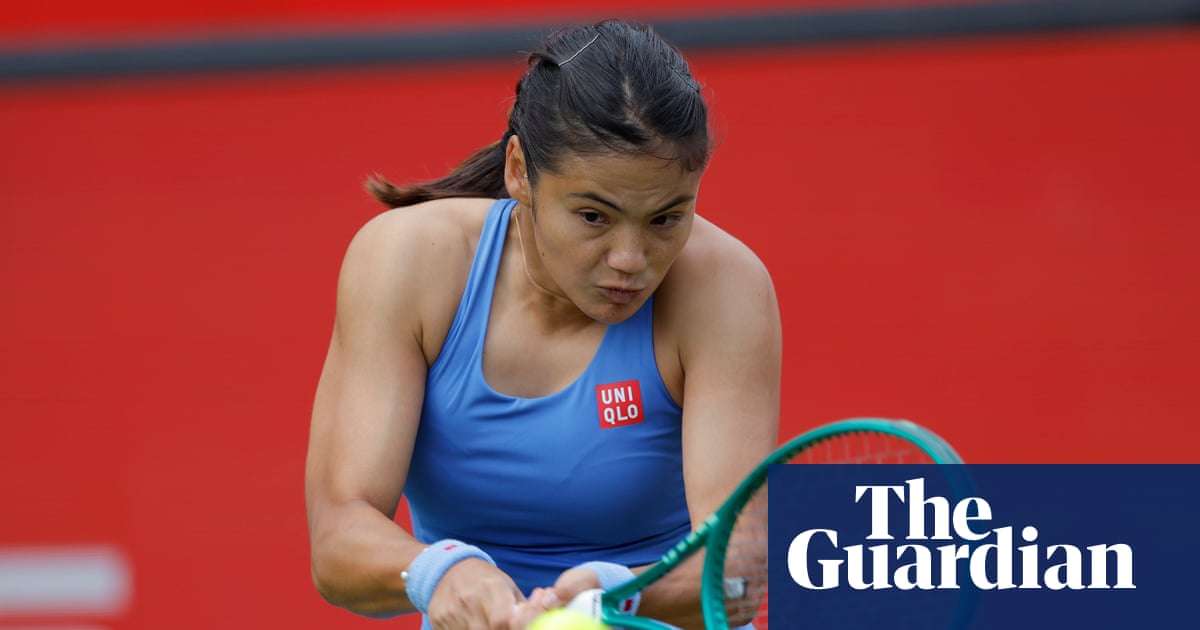
Queen’s, LONDON — Less than a week after the end of the French Open, and just three weeks before Wimbledon, it is raining in west London.At Queen’s, a men’s and women’s tournament two rungs below a Grand Slam, players trying to make the most of their limited time to adapt to the most specialized surface in tennis are waiting for the clouds to clear.Having spent the previous two months on clay, some of the top women’s and, next week, men’s stars are shifting into grass mode.Victoria Mboko, the 19-year-old who will partner Serena Williams in doubles as the 44-year-old returns to tennis, is still learning the surface.“I’m not very familiar on the grass,” the Canadian said.“It’s a little bit tough changing surfaces on the body, but I like doing challenges and I like things that come new to me.”The professional tours run for almost 11 months of the year, with around eight weeks dedicated to the European clay-court swing and the entire grass-court swing lasting little more than four. Since the turn of the millennium, changes in racket technology, balls, and at Wimbledon, the very composition of the grass have meant that players no longer need to do a full change in their tennis identity to succeed on it.But the dexterity, tactical awareness and specialized movement that separate a good grass player from a great one remains, and for any player, it takes practice to get the feet and the mind back in rhythm. For many of them, their first match at Queen’s represents their first match on grass in just under a year — but adjustment comes more easily for some than for others.“When you go into a grass season, it takes me back to my childhood,” Great Britain’s Katie Boulter said in a news conference. “It takes me back to where it started. It grounds me. Being out there on the lawn playing and enjoying myself resonates with me as a child.“That’s why I have so much fun.”The 29-year-old world No. 73 grew up with far greater exposure to grass courts than many of her peers on the WTA Tour, and the contrast between Boulter and Mboko underlines one of the defining features of the grass-court season.Some players arrive with years of familiarity and a game naturally suited to the surface. Others spend much of the brief swing trying to accumulate experience before Wimbledon begins, or, in some cases, just accepting that their grass swing might last little more than two or three matches.The same dynamics occur on clay, but players have more time to make adjustments, and more opportunities to get tournament reps.Tatjana Maria, the champion of last year’s women’s event at Queen’s — the first since 1973 — played qualifying this year. When changing surfaces, lower-ranked players who have gone through preliminary rounds have more time to adapt to conditions, making them dangerous draws for higher-ranked players who are yet to acclimate.“One match definitely on grass and it never hurts,” Maria, 37, said in a news conference. “Players here at the beginning, they have not so much practice time on the grass.”Amanda Anisimova, the American world No. 5, is back at Queen’s after finishing runner-up last year. She was one of several higher-ranked players that Maria filleted with her slice, drop shots and lobs, denying her opponents the opportunity to play the tennis they are most familiar with. The German also has a potent serve, another key weapon on the lawns at Queen’s and Wimbledon.Maria last year defeated two Grand Slam champions (Elena Rybakina and Madison Keys) as well as Anisimova. Having a game that fits grass, especially in its first tournament, can bridge any kind of ranking gap.“It is a very short one, but I try to make the most of it when I do play it,” Anisimova said in a news conference.Maria, who reached the Wimbledon semifinals in 2022, added that the rain delays that have squeezed practice time down even further are simply part of life during the British summer. Spectators huddled beneath umbrellas on Monday morning, checking weather radar apps on their phones as showers swept across west London.Among them were Mark Grayson and Alison Dodgson, attending Queen’s for the third time. Like many regular visitors, they accepted the weather as part of the grass-court experience, but acknowledged that a day lost to rain feels more significant during such a short season.“Queen’s is a lot more intimate than Wimbledon,” Grayson said. “You walk in between the practice courts and you’re a meter away from the players.”The pair spent much of Monday sheltering beneath the awnings around the grounds, waiting for a break in the weather alongside hundreds of other spectators — and the players trying to find their feet on the slipperiest of tennis surfaces. Whether they arrive with years of experience or only a handful of matches behind them, they are all working against the same reality: By the time the grass-court season begins to feel familiar, it is often already nearing its end.

Most Popular

Colombia World Cup 2026 team guide
3 hours ago




Mihocek recovering after surgery on neck fracture
17 hours ago