
Football on the frontline: Why Brazilian talents continue to flock to Shakhtar Donetsk despite Ukraine's brutal war with Russia
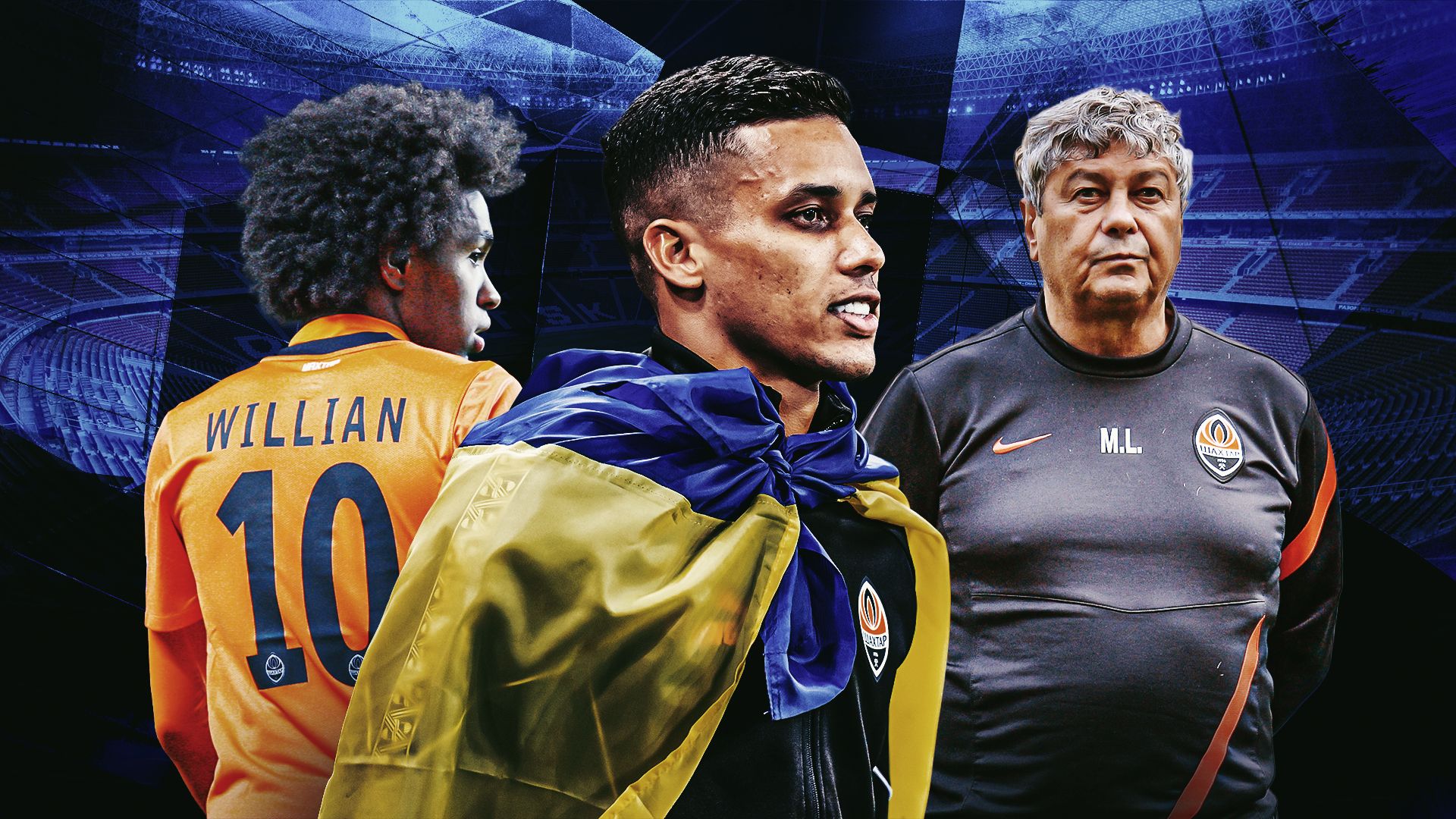
Shakhtar and the city of Donetsk have been on the frontline of the conflict in Ukraine far longer than the four-and-a-half years since Russia's invasion, with the Donbas region at the centre of the early flashpoints that set the two nations on the path to war more than a decade ago.Violence actually broke out there in early 2014, as anti-government paramilitary groups seized control amid pro-Russian unrest in Ukraine at the time. Order was eventually restored by Ukraine, but Donetsk has since been illegally annexed following Russia's full-scale invasion in 2022 and remains under Russian occupation.Remarkably, Shakhtar last played a home game at their state-of-the-art Donbas Arena way back in May 2014, before the stadium was twice damaged by shelling later that year. Their Kirsha training base was also struck, with the vacant players' living quarters on the top floor destroyed in a bombardment.The club has since been in exile, training in the capital Kyiv and playing home matches in Lviv, 600 miles away from Donetsk in the west of Ukraine. Meanwhile, they have been forced to play European 'home' games across the border in neighbouring Poland and in Germany.It's now more than 20 years since Shakhtar first formed its now-renowned Brazilian connection, which was the brainchild of club owner, president and billionaire oligarch Rinat Akhmetov, who was enamoured with the dazzling, dynamic style of football that is synonymous with the South American nation.Young striker Brandao was the first to arrive in 2002, but it wasn't until the late Mircea Lucescu's trophy-laden 12-year managerial reign began in 2004 that things really took off, as he was charged with unearthing the best young Brazilian talents and bringing them in for minimal fees. It was that season that the likes of Elano and Jadson arrived, with the former eventually joining Manchester City and the latter going on to spend seven successful years in Donetsk."The president and I dreamed of turning every Shakhtar match into a show," Lucescu - who passed away earlier in 2026 aged 80 - said in an interview a few years ago. "We wanted to attract fans. That's when the idea to sign Brazilians was born. If we had wanted something else, we would have signed Argentines and Uruguayans. Only Brazilians put on a show."The subsequent years would yield some of Shakhtar's most fruitful and profitable imports from Brazil, including Fernandinho (sold to City for €40m), Luiz Adriano, Taison and Willian (sold to Chelsea for €35m). The former and the latter would become Premier League favourites, while Adriano is the Miners' record goal-scorer with a total of 128 and Taison is their record appearance-maker with 299.But what compelled so many young Brazilians to move more than 10,000 kilometres away from home, to the polar opposite side of the planet, to a country with a wildly different climate, and to join a club that competed in a relatively weaker league?"The president wanted to put Shakhtar and the city of Donetsk on the global footballing map," Ukrainian football expert Andrew Todos, the man behind the @ZoryaLondonsk X account, tells GOAL. "As a result of those Brazilians initially being convinced [to move], they sort of started creating a bit of a Brazilian community in Donetsk."It was pretty bleak there. It's a very industrial town, the average person probably wouldn't want to go to live there, but in their training base, they had a very big group of these Brazilians. They had translators. I'm sure some of their other locals had a few businesses that helped them out . And as a result of that, that's how Shakhtar were able to continue to attract these new and upcoming players."Quite incredibly, the outbreak of war in Ukraine and the upheaval caused by their forced exile has not stopped Shakhtar being able to attract Brazilian prospects, and they reached a very significant milestone earlier this summer.Flamengo's Ryan Roberto remarkably became the 50th Brazilian player to sign for Shakhtar in their history when he completed a €9 million switch in July, which, pretty ridiculously, averages out at more than two per year since their samba-football recruitment drive began back in 2002. Bruninho, another highly-rated winger, has also joined from Athletico Paranaense following his 18th birthday for a pretty significant €11 million (£9m/$12m) fee.It reflects that the city of Donetsk and, since 2014, this displaced football club really has become a Brazilian enclave 10,000km from home.Explaining his decision, Roberto said: "I think one of the things that made me choose Shakhtar was the amount of Brazilians they have here. For having so many Brazilians and for having had many Brazilians before. It's a club that knows how to receive well, and that's what I heard before coming here. It is a club that is prepared to receive Brazilians, it knows how to deal with them."Following Russia's invasion of Ukraine, several foreign players exercised a newly-introduced FIFA rule to suspend their contracts with Shakhtar and subsequently cut ties, including star winger Tete, leading to them competing with a predominantly Ukrainian squad in 2022-23 and giving the likes of Mykhailo Mudryk a platform to shine as they still claimed the league title.But in the summer of 2023, the club was in a position to resume it's famed trading with Brazilian clubs. "Shakhtar won the league and essentially they started bringing in a couple more Brazilians just because they were able to convince them that it was safe enough to do so," Todos explains. "From the different sources I've read, in order to be able to attract people to come to a warzone you have to pay them good wages as well to make it attractive."That community was rebuilding. Shakhtar are now based in Lviv, which is in the west of Ukraine, right near the border with Poland. So, it's probably about an hour, an hour-and-a-half drive to the border and you cross the border, get on your flight from Poland and fly home, fly to Europe, wherever you want to go. Shakhtar were able to create this community again, they were just building gradually."Indeed, the club's renowned connection with Brazil is going from strength to strength; at the time of writing, they have a record number of Brazilian players on their books with 14, despite the war in Ukraine seemingly having no end in sight.For his part, Palkin is convinced that the opportunity to fast-track your progress to the highest echelons of European football is what continues to drive Shakhtar's recruitment from Brazil, in the face of the bitter conflict with Russia. It goes without saying that the wages on offer are also significantly better than what these hopefuls would be paid in their homeland."Our war started from 2014, when we left our home city Donetsk," the CEO tells GOAL. "Before that it was much easier because when players come in, they see our beautiful stadium, one of the best in Europe at that moment, and our training camp, etcetera."From an attractiveness point of view, like club infrastructure, we had a much, much stronger position before 2014. And after we left our city after 2014, and after 2022 [Russia's full-scale invasion], you know, it's become much, much more difficult to attract [talent from Brazil]."Everybody knows that we are not selling comfort, because it's impossible to have comfort having war in the country. But we are selling them, let's say, their career factory, career development, because they all understand that if they come to Shakhtar, it's the shortest way to go to the top-five leagues in Europe."We are a well-known club in the Brazilian market at this moment. Brazilian talented players, they trust us, they trust our scheme of working, they trust how we adapt quickly and how we operate with them, because it's one thing to find a talented player, but another one to develop them."The major message is that we are not selling comfort, we are selling their future and therefore they come to us and they trust us. They understand if they choose us, we know how to operate with Brazilian players, how to develop them and how to promote them."Among the 50 Brazilian players to have joined Shakhtar down the years, and the 14 currently on their books, is forward Pedrinho. Something of an elder statesman, the 28-year-old actually joined the Miners from Benfica in 2021 before the outbreak of war, but remains with the club to this day, albeit he returned to his homeland on a two-year loan to Atletico Mineiro."I think when you see that there are so many Brazilians at the club, it makes you even more interested in coming here," the winger tells GOAL. "When I arrived, I did my research on Shakhtar and saw how many Brazilian players were here, so I knew it would make my adaptation much easier and much faster. I think that's a very important factor."We're happy to have as many Brazilians here as possible because it makes everyday life easier. And whenever new Brazilian players arrive, we try to help them in any way we can."One of the things that made me happiest when I arrived was how easy it was to connect with people. We know that moving to European football can be difficult. You have to adapt, communicate in a different environment, deal with the cold and the time difference. So having a lot of Brazilians around makes things much easier."It gave me a great starting point, especially the first time I came to Ukraine, because I already had friends here whom I knew from the youth national teams and from previous clubs. That helped me a lot as I settled in and developed here."The Ukrainian players and staff at the club also go out of the way to make their Brazilian colleagues feel as welcome as possible. "They respect us a lot, and we respect them too because, whether we like it or not, we're in their country," Pedrinho says. "But they're wonderful people and they make us feel comfortable."In the dressing room, for example, they let us play our music. They also give us their full support whenever we're going through difficult situations. If that wasn't the case, I think adapting would be much harder. But because they're as welcoming as they are, it makes everyday life much easier. On our days off, everyone gets together. That helps a lot with team bonding, both on and off the pitch."Inevitably, though, life in a warzone is not always rosy for the Shakhtar squad and their Brazilian contingent, with the situation particularly tough for the younger players in the group. In Lviv, hundreds of miles away from the frontline, the blaring sound of air-raid sirens is a regular reminder of the ongoing conflict.Pedrinho tells GOAL that he and his family were forced to take shelter in the parking garage under their house a matter of weeks ago after there was an alert in the middle of the night."The biggest challenge is staying mentally strong," the forward said. "When you come here, you already know the situation you're getting into, but at first it still affects you mentally. That's why we try to support the younger players. We tell them that this will pass and we pray that it will be over as soon as possible."But I think footballers also bring a little bit of joy to the people who live here. Watching a game, going to a stadium and seeing something different can help people enjoy themselves and have a moment of relief while all of this is happening."But it's not easy. A lot of players are far away from their families and end up going through difficult situations, with the (air-raid) sirens and having to go to bunkers, only to wake up the next day and go back to living their lives as normally as possible."Palkin says the club is doing its best to ensure its new normal doesn't negatively affect their playing staff. "We are trying to make the life of our players much easier," he says. "Some of the players live in a hotel and they don't have an apartment because their families live abroad. Their families are afraid sometimes to come to Ukraine."Can you imagine this kind of life where you just stay in a hotel, go opposite the hotel where we have a pitch, you go, have training and go back to the hotel? I mean, it's not like normal life. Sometimes our players didn't see their families for two months, three months."The travel involved because of the club's 12-year-long displacement is also incredibly taxing for the players."It has changed a lot, especially when it comes to logistics," Pedrinho says. "I used to live in Kyiv with my entire family, and we would always play our home games there. We had our own stadium in Kyiv, a top-class stadium where we also played our Champions League matches. That's no longer possible."Now we always play away from home and we don't have a permanent home venue. That takes a huge toll because we often arrive at games more tired after spending so many hours traveling. At the beginning, when it came to accommodation, we never really had a permanent place to stay. We'd spend a month in Kyiv, then a month in Lviv. These days, the club tries to keep us in Lviv, which is better for us."Pedrinho is currently sidelined with a muscular problem that he attributes, in part, to the added travel. "It's one thing to be at home and then travel to a game," he says. "It's another thing to spend 10 or 12 hours on a bus just to play a match and then have to come back and play in the Ukrainian league a few days later."There is always that risk, and sooner or later you can end up suffering an injury because of all those long journeys. But that doesn't change the fact that whenever we step onto the pitch, we try to give our best."But it's not easy. A lot of players are far away from their families and end up going through difficult situations, with the (air-raid) sirens and having to go to bunkers, only to wake up the next day and go back to living their lives as normally as possible."A half-century of signings from Brazil is certainly worth celebrating, and the connection is a badge of honour for the club, but at its core this is simply a very successful business model that has been adapted for Shakhtar's current predicament."War is not an excuse for us," Palkin insists. "War, it's even pushing us to adapt, pushing us to make quite quick decisions and analyse deeply. For example, we increased the number of our scouts in Brazil and we are trying to set up quite sophisticated analysis before buying Brazilian players."Therefore, we are developing and because we understand that this kind of direction brings us not just sport results and also financial results."Indeed, the club has continued to trade well in the transfer market since the war began in early 2022. "Evidently they had Mudryk, got a nice fee for him [£89m from Chelsea]," Todos explains. "And then they've sold Kevin to Fulham for almost €40 million. So they made their money back there and he wasn't that cheap [in the first place]."And then they brought in a number of others. Marlon Gomes, Alisson came in last year and a number of others, and that community was rebuilding."Winger Kevin is an example of how Shakhtar have tweaked their strategy in recent years, effectively pivoting to 'flipping' players in a short timeframe rather than holding onto them and developing them over a longer period. He was signed from Palmeiras for €15m in January 2024 and sold to Fulham for more than double that amount just 19 months later."Kevin stayed with us just one-and-a-half years almost before he was sold," Palkin explains. "Because of the war, we also changed our ways of developing players. Because, for example, before 2014, before 2022, Brazilian players who came to our club had two years for adaptation."But now we don't have this kind of time. We buy a player and he plays directly. We shorten this time for adaptation almost to, I don't know, to zero."David Neres was another relative success story; the winger didn't play a single game for Shakhtar after arriving from Ajax just before war broke out in a €12m deal in January 2022, but the Ukrainian giants still managed to sell him for a €3m profit just six months later when he joined Benfica."Regardless of the sort of difficulties that we've been speaking about with the war with, air-raid alerts, with missiles and all this kind of thing, they have returned to what they have always been known for over the past 20 years and know that it's a proven business model," Todos says.However, while Shakhtar were pioneers in the early 2000s, copycat business models are now popping up across Europe, with every mid-size to elite club seemingly out to unearth the next potential €100m player in every corner of the planet. That poses a significant challenge for the Ukrainian giants.Against the backdrop of the war and their ongoing displacement, Shakhtar are struggling to compete against financial might of sides from the Premier League and beyond. Chelsea wonderkid Estevao Willian is case in point; he was a key target for the Miners before heading to Stamford Bridge."Chelsea have changed the market in Brazil," Shakhtar's sporting director and club legend Darijo Srna told ESPN recently. "They are buying players not just in Brazil, but Argentina and Ecuador who are 16 or 17 years. Manchester City look too. For us it is more difficult than before, but there is still a lot of talent in Brazil. Estevao for example, was on our list, but it is difficult to fight with Chelsea."Just this summer, Shakhtar missed out on another Brazilian youngster they had pursued extensively - coveted 18-year-old, Gabriel Mec. "We negotiated almost three months with Gabriel Mec from Gremio," Palkin tells GOAL. "Finally he moved to Porto because, having the same conditions, players prefer to stay in a country where there is no war, and we understand this."The fresh competition and Shakhtar's obviously disruptive circumstances have led them to tweak their sights, instead shifting their focus to even younger players, like Bruninho, whom Europe's elite are perhaps not yet ready to take a gamble on."At this moment, it's quite difficult to compete on the Brazilian market because now the top European clubs go directly to Brazil, pay 40, 50 million for talented guys. Therefore for us, it's quite difficult to operate," Palkin admits."But we adapted, our president is not afraid to invest in talented players. For example, Bruninho, we signed him when he was 17 years old. So we are trying even to go down from an age perspective. He couldn't play [initially] because he was 17, but he turned 18 and he started playing."This new competition has put a real emphasis on the need to qualify for the Champions League each season to continue to be an attractive proposition and keep the business model afloat. However, the decline of the Ukrainian Premier League as a direct consequence of the conflict means it has fallen in UEFA's coefficient rankings, providing yet another obstacle.Thankfully, Shakhtar have been given direct passage to the league phase of the competition for 2026-27, by virtue of topping the Ukrainian league and being handed the spot designated to the Ligue 1 champions, because Paris Saint-Germain won the 2025-26 edition and have taken the place allocated for the defending champions. Otherwise they would have had to go through the lottery of qualifying.Last season, the Miners had to make do with a place in the Conference League after finishing second in the league in 2024-25 and losing a Europa League qualifier, albeit they did reach the semi-finals before being downed by eventual winners Crystal Palace.Palkin is under no illusions that Champions League qualification is a key aspect of the business model and drives recruitment from Brazil. "Now we are concentrating more on bonuses which we receive via competitions and transfer of players," he tells GOAL. "That's two of the biggest sources of income."They [Brazilian prospects] understand if they go to Shakhtar, they go and play directly in the Champions League. And for me, Champions League is the number one competition in the world. Therefore, everybody wants to be presented there. Everybody wants to play there, Brazilian players dream of playing in the Champions League. Therefore, they choose us."From Todos' perspective, the strategy of signing young prospects from South America has become almost cyclical. "The priority for Shakhtar is not just selling those players [they have developed] or working for that, it's actually buying these players to qualify for the Champions League because that's the biggest cash cow," he says."Then, as a by-product of them making the Champions League, they've now then got a window to sell those players and also prove to scouts that these players can play in a top-level competition. Trying to get big fees for players purely based on their Ukrainian Premier League performances I think, sadly, doesn't really cut it anymore, and it hasn't done for the past five years or so."Shakhtar are already off the mark in the 2026-27 league phase after matchday one, holding Dutch giants PSV to a creditable 1-1 draw in Eindhoven.That Champions League journey will bring the club to English shores, as Shakhtar look to exploit another commercial opportunity and create a new revenue stream in the face of the significant challenges they face.In July, it was reported that the club was in talks with London clubs Chelsea, Fulham and Brentford over potentially hosting their Champions League home games at one of their stadiums, given none of them are in European competition themselves in 2026-27.It then emerged in August that Shakhtar were advancing in talks with Chelsea over using Stamford Bridge, with the Blues keen to help a club with whom they share a good relationship, albeit a fee will still be involved. The agreement was subsequently confirmed towards the end of August."Playing our Champions League home matches at Stamford Bridge is a special opportunity for Shakhtar," the Ukrainian club said in a statement. "We are grateful to Chelsea for the opportunity to host our games at this special venue. Stamford Bridge is one of the most famous stadiums in world football, with an incredible history and atmosphere."There is a big Ukrainian population in London, which has grown larger still as a result of the war, as many have been forced to flee to the English capital. As of March 2023, 169,300 people had arrived in the UK on one of the Ukraine Visa Schemes since they were introduced a year prior, per the Home Office. The city is also home to a vibrant Brazilian community."From the beginning of the war, we played in Poland, we played in Germany. Now we make a decision to move to England because it's a new market," Palkin explains. "To be honest, it's the capital of world football in respect of attractiveness from a communication point of view, sport point of view, financial point of view."You asked about how the war impacts the model of our business. This is the impact. We are trying to present ourselves in the cities and countries where there are a lot of Ukrainians because we want them to see our matches."And from another aspect, from a financial point of view, we are trying to find places which can bring us more income and maximise sales of tickets. We are trying to adapt to a new reality of our life."Appointing explosive former Turkey and Barcelona midfielder Arda Turan as head coach in May 2025 has also proven to be a commercial boon, as Shakhtar have unexpectedly built a Turkish fanbase - evidenced by a recent friendly away to Bursaspor attracting a 43,000 sell-out crowd.The move to play matches in the UK is another demonstration of how Shakhtar have adapted to their new reality, trying to extract all possible good amid the desperate situation in their home country.On the pitch, Turan's side reclaimed their domestic crown from rivals Dinamo Kyiv at the end of 2025-26 despite their exile and, as we've touched upon, that (and UEFA's coefficient) has secured them direct progress to the Champions League league phase. Continuing to play in Europe's premier club competition is essential."You can be extremely positive, and I'm sure that maybe some of the Shakhtar hierarchy are, but even they understand that it (returning to Donetsk) seems like a very unlikely scenario," Todos tells GOAL. "And as a result of that, I think they're trying to broaden their horizons. Hence why they're coming to London."They are always innovative in the way that they try to deal with these scenarios and I think they have to be because it's very much been about survival over the past decade. It does also help that they have got a wealthy owner to act as a fallback and the insurance of all of that."But on top of that, they are getting the results. We'll see what the coming years bring, but I think that they will be trying to steadily rise up to try and at least sell more big players consistently, appear in the Champions League more consistently, and make more partnerships across the world."Against all the odds, the club's ever-evolving new business strategy still relies on enticing up-and-coming talent from Brazil. They are leaning into their stellar reputation as the ideal launchpad for a successful career in the promised land of Europe. As Palkin so proudly proclaimed, "Brazilian players are part of Shakhtar's identity"."I think it is still very much a stepping stone," Todos says. "And I think Shakhtar aren't masking that, they understand that you can still make a name for yourself in the Ukrainian Premier League regardless of how weak it's become on a whole from a level of football standpoint, but with your performances in European competitions you can then get yourself a move to the Premier League, Italy, Spain or wherever you want."Asked why Shakhtar remain such an attractive proposition back in his homeland, Pedrinho tells GOAL: "If it weren't for the war, I always joke that Shakhtar would be the best club in the world to get your career started."Here, if you're 18 or 19, you have a great opportunity to play regularly and compete in important competitions. I think that attracts a lot of young players who want to show their potential to the world. A lot of times, you take the next step to a bigger club but don't get the playing time you were hoping for, and I think Shakhtar gives you that opportunity."The war obviously makes things more difficult, but I think what still attracts players is the number of Brazilians who are here. If there were only one or two Brazilians, I think it would be very difficult for people to want to come here, especially after the war began. But because there are so many Brazilians, it makes the move much easier."And amid everything else, Pedrinho insists football remains a source of overriding happiness for the players: "Despite all the things that have changed, what remains is the football and the joy of doing what we love most."


.jpeg?width=1200&auto=webp&quality=75)

Most Popular






Leeds news: Fan views on European football talk
2 hours ago