Another set of Sullivan brothers are making football waves in Bangladesh
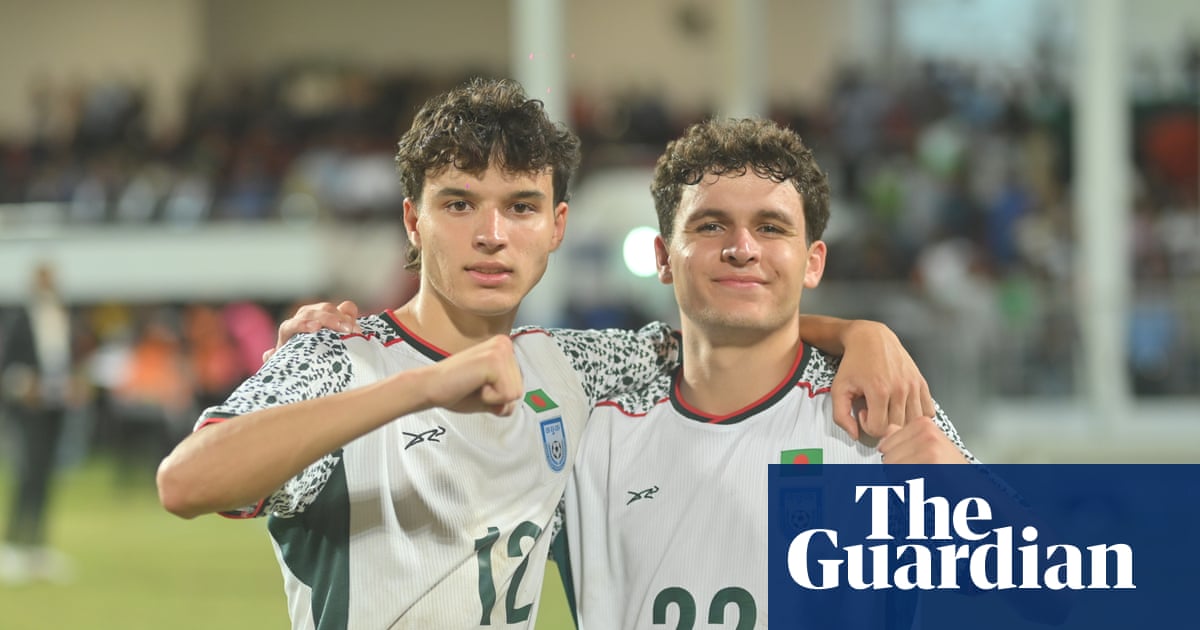
Ronan Sullivan had tried a panenka twice in his life. Both attempts were at practice on the other side of the world, and one hit the crossbar. But his twin brother, Declan, was hardly surprised when Ronan turned to him and told him he’d chip the fifth penalty of a shootout that could win a scoreless tournament final, as millions tuned in online to see his Bangladesh side play against India in the Under-20 South Asian Football Federation (SAFF) Championship.“He didn’t even need to say it. I knew he was gonna do that the whole time,” Declan remembered, sitting next to his brother on the couch of their dorm room at Saint Joseph’s University. “I knew that if he got the last pen to win it, he was gonna do that. That’s just the him thing to do.”Moments later the ball gracefully splashed into the back of the net, and the thousands in attendance on 3 April in Malé, Maldives erupted.“I wouldn’t have believed you if you told me it [would have] went like that,” Ronan said.Less than two years after he began exchanging messages on Instagram with the “Save Bangladesh Football” fan page, the brothers were celebrating a U-20 title, made possible by their maternal ancestry, as members of essentially the home team. (Bangladesh is the largest source of migrant workers in the Maldives.)“Flying in there alone was incredible. Like the water’s so blue. I’ve never seen anything like it. Like we go to Ocean City, New Jersey, where the water is brown, and it’s our favorite place ever,” Ronan said. “So when we saw this water, we were like, ‘Oh my gosh!’ It looked like the water from [the movie] The Waterboy. At the end [of the movie], that special water … I think it’s just Maldives water.”The story seems ripped from the pages of a Hollywood script. Two kids from Philadelphia with very Irish names who had never visited Bangladesh before their tryout for the country’s U-20 squad prior to the tournament, then returned to its crowded capital triumphantly. They allowed a few days for the media frenzy, and a few more for themselves to explore, enjoy the food and time with their grandmother, whom they’d only seen in the US until this trip.But this could be part of the opening scene for Bangladesh, ranked 181st by Fifa, with nearly 180 million people and, according to the United Nations, the world’s sixth-largest diaspora. The vast majority of it is concentrated in southern Asia or the Middle East, but there’s a well-established community in the UK, growing ones in the US and Italy, and pockets elsewhere in the West.“I think a lot of people saw what we did over there and saw how good of an experience that was, and now all of a sudden I’m seeing a lot of foreign players interested in playing for Bangladesh, a couple kids from England who are on pretty good academies over there, so we have talent all around the world. It’s just about utilizing that,” Declan said.The Sullivans are well known in Bangladesh, the US and beyond, and so too is former US men’s national team captain Thomas Dooley. The son of an American serviceman who grew up and played in Germany then joined the USMNT by happenstance, Dooley was announced as the head coach of the Bangladesh senior team seven weeks after the U-20 side brought a trophy home. He spent most of the coaching chapter of his life in Southeast Asia, where he heard about “a fanatic country in football” he is now leading into a new World Cup cycle.“We are a country of being fans. We need to change that. We need to be a country of playing football,” Dooley told the Guardian. “That’s what we need to be, and we need to find a way to do that.”Ronan, Declan, and their brothers Quinn and Cavan – both attackers for the Philadelphia Union – were eligible to play for the US and Germany as well as Bangladesh. While Quinn was cap-tied by the USMNT last summer and Manchester-City bound Cavan is a top American prospect, the twins were more realistic bets for Bangladesh.“It all started with an Instagram DM, which is kind of crazy,” Declan recalled. The message came from that Save Bangladesh Football account. Initially confused that a fan page was encouraging them to come for a camp before they had a passport, Ronan and Declan soon realized the account was a legitimate asset and facilitator for the federation, eventually connecting the Sullivans to federation vice-president Fahad Karim when they expressed interest in the SAFF U-20 tournament.“[We had] a bit of time before college. It would be awesome to go play, represent the country, become more part of the culture,” Ronan said. The next three months were “a bit of a crazy process,” primarily because obtaining a Bangladeshi passport when their mother didn’t have one wasn’t straightforward. But in March the twins flew from New York to Delhi, then Delhi to Dhaka, easily the longest journey of their lives.There wasn’t a red carpet waiting for them, though. They had not been promised spots in the squad, arriving for a camp with more than 30 players, including three fellow “origin” players whom the Sullivans knew of and could easily communicate with. The manager spoke English too but on the pitch, to varying degrees, there was a language barrier.“When you’re foreign, it’s harder to get the ball at first because you don’t speak the language and maybe the guys weren’t super thrilled that we’re there. But once you get the ball a couple times and show what you can do, it helps out,” Ronan said. After a few days of training they were confident they’d make the roster, and socially their integration progressed.Dooley adamantly defends the right of players with Bangladeshi roots to choose their national team. His Asian coaching odyssey started in the Philippines, where he shrugged off many fans resistant to foreign-born recruits, and he’s encouraged by the culture of the Bangladesh senior team he’s inherited, highlighting the leadership and humility of Leicester City midfielder Hamza Choudhury.“Everybody was happy that Hamza came in, and they understand – the players understand that international players can help them because they can look up to them,” Dooley said. “What kind of attitude they have, the work ethic that they bring in. So everything, they can look up to them, how they handle stuff.”The more they search for players abroad, the more they find – not necessarily in a major European league but at a level that can raise the standard of the pool. But it’s a balancing act. Dooley is getting “thousands” of messages about players and acknowledges “we have to be careful,” noting the budgetary constraints.“It’s not everybody who sends a picture of a free kick that he does is a good player, or maybe can help us. We have good players in this country over here too that we can actually afford,” he said. “We are not spending $2,000, $3,000 on a player to bring him over, and he’s sitting on the bench. So if the players who are coming over are the ones that really can help us, otherwise we’re using that money and putting all the local players in the camp and train them twice a day for two weeks, and you will see that they’re getting much, much better.”Dooley says that coaching a decent group of players who can cover plenty of ground to change the way they think about the game – “most of the players, they don’t think, they play” – and to limit mistakes can improve the team 20 to 30%. He thinks climbing to the 150s of the FIFA rankings is certainly achievable.Of course, there’s a much bigger dream than that.The Instagram comment sections of all four Sullivan brothers have been flooded with Bangladeshi flags for years. The twins were checking their phones in the Maldives, absorbing as the buzz online reached a different stratosphere. They noticed the rivalry with India in particular.“They were making edits of me walking a dog that was painted like the Indian flag. Like it was crazy. There was a lot of heat there, for sure. A lot of tension,” Ronan said.The fervent support in the Maldives created an atmosphere they had never felt on the pitch, a surreal experience that carried into a heroes’ welcome in Dhaka.“That was a lot. Got a lot of flowers, met a lot of people. I feel like our team was the hot new thing in Bangladesh,” Declan said. Indeed, when the Sullivan twins walked around Dhaka they already stood out because, in Declan’s words, “we’re white, for everyone there at least.”“We met a bunch of people, and everyone was so happy and so grateful that we brought the trophy back to the country. Like they were really, really hype about that, and that’s not something you would see in America [for] youth soccer.”And you probably wouldn’t see a media presence at the airport for a senior national team almost anywhere, no matter the circumstances, comparable to what met Dooley at the airport when his group departed for a friendly against San Marino in June.“I thought we are going to the World Cup,” Dooley said. “I was like, this is amazing, and I cannot imagine [the scene] if we would qualify for the World Cup.”“I think the country would explode if we qualify for a World Cup,” Ronan said.It seems far-fetched. No country from the Indian subcontinent has ever appeared at a men’s or women’s World Cup. Its viral passion for international soccer continues to be channeled towards South American giants.However, with further expansion of the men’s World Cup looking inevitable, and a bridge to their diaspora being built, a new dimension awaits this sport in Bangladesh. Something even greater awaits if a country from the subcontinent can qualify. While recruiting players is increasingly common in international sport, what it could unlock in this scenario is rare.“Whenever I think about the 64 team [World Cup], I’m thinking, ‘Look, if we get all these players, we have a chance to qualify.’ Like, that’s the dream. That’s the ultimate goal,” Declan said. He mentioned his friend, former Union academy teammate and Penn State winger Nehan Hasan, and Stanford striker Trevor Islam as possible additions, and hopes there will be many more candidates.“We have to convince them. We have to tell them you can actually leave a legacy here in this country,” Dooley said about eligible players.Dooley preaches qualifying for the Asian Cup (the Bangladesh men only have once in their history) or the World Cup is a process, but in the same breath he says “it can go fast”. He mentions 19-year-old winger and Fulham academy product Farhaan Wahid and 25-year-old Louie Watson, an attacking midfielder in the English fourth division, as the next potential pieces for his project. Choudhury and a New York Cosmos summer signing, Canada-born midfielder Shamit Shome, are the cornerstones. Dooley stresses that goalkeeper will be a key position to address.After their fall friendlies, the next notable step for the program will be the senior level SAFF Championship in Bangladesh in November. Bangladesh have won the tournament just once, as hosts in 2003. It’s Dooley’s main focus, but after that, he’s planning to be more involved in the development of the sport domestically. In his view, it’s a top-down mission: the success of the senior team drives the interest, sponsorship, and investment for a proper pyramid structure, with youth academies feeding adult leagues.Until he moves into an apartment in the affluent Gulshan area of Dhaka, Dooley is living at a hotel. He’ll look out the window at densely populated high-rise buildings, lamenting only a school or two in sight with a soccer field. This is the deeper challenge, one of infrastructure, culture and mindset for the next generation.“We would love to have the kids not want to be a fan of Argentina. They want to be a player to play against Argentina, against Brazil,” he said.


Most Popular